CNC Machining Aircraft Parts
CNC Machining Aircraft Parts
Manufacturing aircraft components presents unique challenges that require the highest level of precision and reliability. Ensuring safety-critical tolerances, handling complex geometries, and meeting stringent aerospace material and quality standards are constant concerns for engineers and manufacturers. A robust CNC Machining Aircraft Parts process addresses these issues through advanced tooling, precise programming, and rigorous quality assurance.
Whether you require cnc machining aircraft parts for engine components, precision cnc machining of aircraft structural parts, or cnc machining of aircraft interior parts for enhanced comfort, understanding the complete machining workflow is essential for producing high-performance, safe, and reliable parts.
Understanding CNC Machining in Aircraft Part Production
CNC (Computer Numerical Control) machining is a cornerstone technology in the aerospace industry. By using computer-controlled machines, manufacturers can produce intricate components with tight tolerances, complex shapes, and repeatable quality that conventional methods cannot achieve.
The versatility of CNC machining allows it to be applied across engine parts, structural assemblies, landing gear components, interior panels, and more. Aerospace-grade materials such as titanium, aluminum alloys, Inconel, and high-strength steels are commonly machined to meet both performance and safety requirements.
Step 1: Material Selection and Preparation
Choosing Aerospace-Grade Materials
Material selection is critical for aircraft parts due to performance, weight, and regulatory requirements. Key material considerations include:
Aluminum alloys: Lightweight, corrosion-resistant, and suitable for structural and interior components.
Titanium: High strength-to-weight ratio, ideal for engine and airframe components.
Inconel: Exceptional high-temperature resistance, used in engine parts and exhaust systems.
High-strength steels: Used for landing gear and high-load components.
Material Inspection and Preparation
All raw materials undergo strict inspection for composition, structural integrity, and stress levels. Ensuring material consistency minimizes defects and deformation during machining, which is vital for safety-critical components.
Step 2: CNC Machining Process
Design and Programming
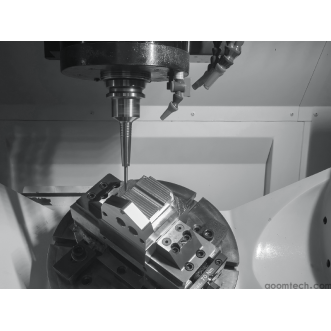
The process starts with detailed CAD modeling to capture all critical dimensions, tolerances, and functional requirements. CAM (Computer-Aided Manufacturing) software then generates optimized toolpaths for multi-axis CNC machines.
Advanced strategies are employed to handle complex shapes, reduce machining time, and maintain dimensional accuracy. For precision cnc machining of aircraft structural parts, tolerances often require micron-level precision, demanding meticulous planning and tool selection.
Roughing and Finishing Operations
Roughing removes bulk material efficiently, followed by finishing passes to achieve the precise geometry and surface finish required. Techniques such as high-speed milling, adaptive toolpaths, and multi-axis machining ensure parts meet stringent aerospace standards.
During machining of cnc machining aircraft parts for engine components, controlling heat and stress is crucial to prevent warping, which could compromise safety and performance.
Secondary Features and Complex Geometries
Modern aircraft components often include complex geometries like internal channels, curved surfaces, and integrated assemblies. CNC machining allows precise creation of:
Threaded holes and inserts
Channels and cooling passages
Complex contours and airfoil shapes
High-strength joint features
These operations require multi-axis machines and careful planning to ensure accurate execution without compromising structural integrity.
Step 3: Quality Control and Inspection
Dimensional and Geometrical Verification
Given the critical safety requirements, all machined aircraft parts undergo rigorous dimensional inspection using:
Coordinate Measuring Machines (CMM)
Laser scanning and optical measurement systems
Micrometers and precision gauges
Material and Functional Testing
Additional tests verify material properties, surface finish, and structural integrity. Common procedures include:
Hardness and tensile testing
Non-destructive testing (NDT) such as X-ray or ultrasonic inspection
Surface roughness evaluation
Assembly and functional verification for fit and operation
These steps ensure that every aircraft component meets or exceeds regulatory and performance requirements.
Benefits of CNC Machining in Aerospace Applications
CNC machining offers multiple advantages in aircraft part production, including:
Exceptional precision for safety-critical components
Ability to machine complex geometries with tight tolerances
Consistency and repeatability for mass production
Optimized material utilization and reduced waste
Enhanced surface finishes and component reliability
For cnc machining of aircraft interior parts for enhanced comfort, CNC technology ensures seamless, high-quality finishes that meet aesthetic and functional requirements simultaneously.
Conclusion
Manufacturing high-performance, safe, and reliable aircraft components requires a comprehensive CNC Machining Aircraft Parts process. From material selection and design optimization to multi-axis machining and rigorous quality control, every step contributes to producing parts that meet the demanding aerospace industry standards.
Explore our full range of CNC machining capabilities for aerospace and aviation applications:
CNC Aircraft Components | Precision Aerospace Machining | Custom CNC Aircraft Parts
RELATED PRODUCTS
-
Professional CNC Machining for Titanium
-
5-Axis Precision CNC Machining Services
-
CNC Machining Services for Custom Mechan
-
CNC Machining Engineering Plastics Servi
-
CNC Machining Service Provider for Tungs
-
High-Volume Small Part CNC Machining
-
CNC Machining for Non-Standard Custom Pa
-
High-Volume Automotive Parts CNC Machini
-
CNC Machining Aircraft Parts
-
Aluminum Parts CNC Machining Process