


How to Choose a CNC Machining Service: Key Factors for Quality, Cost & Lead Time
How to Choose a CNC Machining Service: Key Factors for Quality, Cost & Lead Time
Finding the right CNC machining service impacts your entire production timeline. As a procurement manager or engineer, your job depends on sourcing parts that match the print exactly. A low piece-price means nothing if parts fail inspection or arrive three weeks late.
The manufacturing market is shifting. Suppliers face tighter tolerances, complex geometries, and raw material disruptions. Choosing a partner requires looking past their basic quote. You must evaluate their shop floor engineering, quality control equipment, and machine performance. This guide covers how to select a CNC machining service that delivers quality, balances cost, and hits deadlines.
Assess Technical Capability on the Shop Floor
A capable CNC machining service must own the right equipment for your specific geometry. You need to know if your parts will run on a standard 3-axis VMC or a 5-axis mill-turn center. Complex aerospace and medical parts often require multi-axis machines to reduce setups and prevent accuracy loss.
Machine Condition and Maintenance
Ask prospective machine shops about toolroom maintenance. Precision parts suffer when machines suffer from spindle runout. If the spindle wobbles even a few microns, surface finishes degrade and tools break early. Ask how the shop manages ball screw backlash on aging machines. Backlash introduces positioning errors during circular interpolation. High-end shops use linear scales to bypass this issue entirely. They also monitor thermal drift.
Tooling and Machining Strategies
The shop's actual machining strategies dictate part quality and cost. Efficient shops favor climb milling over conventional milling for most metals. Climb milling pulls the material into the cutter, creating thinner chips and reducing work hardening on difficult materials like stainless steel or titanium.
For high-volume parts with tight surface finish requirements, ask if they utilize a specialized finishing pass with a wiper insert. A wiper insert flattens these ridges, allowing the machinist to run a larger stepover without ruining the surface profile.
Validate Quality Control and Inspection Hardware
Advanced Metrology
Review the inspection room before placing an order. A tier-one CNC machining service relies on a programmable CMM. An automated CMM eliminates human error during inspection. For complex parts, manual micrometers cannot verify geometric features accurately.
GD&T and Statistical Compliance
Your engineering prints contain GD&T callouts. The CNC machining service must prove they understand how to measure true position, flatness, and runout. Ask for a Cpk report on sample runs. A Cpk value of 1.33 or higher proves the shop holds a stable process over time.
Optimize Cost Without Sacrificing Quality
Fixturing and Setup Costs
Every setup adds cost. Complex parts face fixture deflection if the clamping force deforms thin walls during machining. Experienced shops design custom modular fixtures to support the raw stock evenly. If a shop quotes high setup fees, ask if they can run the parts on a tombstone fixture inside a horizontal machining center.
Material Selection and Work Hardening Challenges
Tough alloys like Inconel or 316 stainless steel generate immense heat. If the machinist uses wrong feed rates, work hardening occurs instantly. The material becomes too hard to cut, destroying expensive tools. A knowledgeable CNC machining service adjusts toolpaths to maintain constant engagement, keeping heat away from the workpiece.
Evaluate Lead Time and Supply Chain Reliability
Production Scheduling and Capacity
Ask how the supplier tracks open machine hours. A reliable CNC machining service schedules regular preventative maintenance during off-peak shifts. This protects your delivery dates from unexpected machine breakdowns.
Secondary Operations Management
Most CNC machined parts need anodizing, heat treating, or plating. A top-tier CNC machining service manages these sub-tier vendors closely. They take full ownership of the final part print, guaranteeing that post-processing does not push critical dimensions out of tolerance.
Summary Checklist for Sourcing Teams
✅ Check that the shop uses a programmable CMM to verify GD&T callouts and true position requirements.
✅ Confirm the shop manages spindle runout and ball screw backlash to keep parts within specification.
✅ Ensure engineers utilize optimized climb milling and finishing pass tactics to avoid work hardening.
✅ Verify they can measure surface finishes using a calibrated Ra scale profilometer.
✅ Review Cpk process control data for high-volume orders to guarantee manufacturing repeatability.
Sourcing a CNC machining service is about establishing technical alignment. By focusing on machine metrics, inspection hardware, and shop floor strategies, you protect your production line from quality issues and late deliveries.
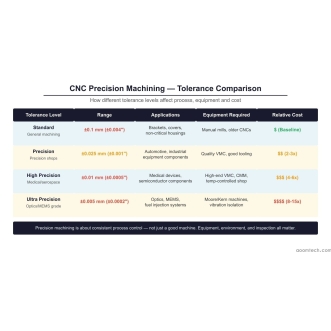 CNC Precision Machining Parts:
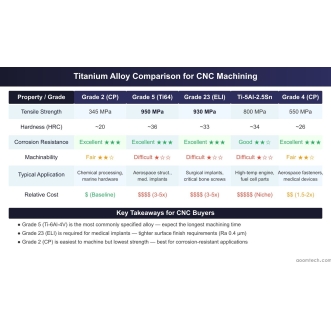 CNC Machining Titanium: Alloys
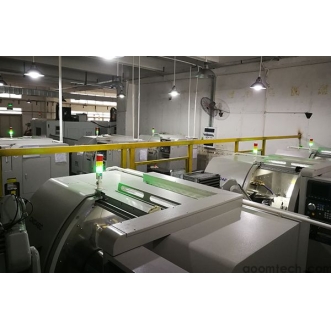 CNC Machining for Automotive:
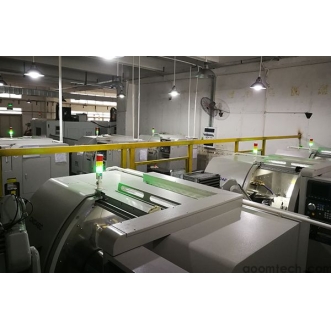 How to Choose a CNC Machining