


CNC Machining for Aerospace: Materials, Tolerances & AS9100 Certification Guide
Why CNC Machining is Critical for Aerospace
The aerospace industry demands perfection. A single failed part at 35,000 feet is not an option. CNC machining delivers the precision, repeatability, and traceability that aerospace components require. This guide covers materials, tolerances, certifications, and design tips for aerospace CNC machining.
Key Aerospace-Grade Materials
Material selection in aerospace is driven by the need for high strength-to-weight ratios, temperature resistance, and fatigue life.
Aluminum 7075-T6
7075-T6 is the most widely used aluminum alloy in aerospace. It has a strength comparable to mild steel at one-third the weight. Used for wing ribs, fuselage frames, and bulkheads. Machines well with sharp carbide tooling.
Titanium Ti-6Al-4V (Grade 5)
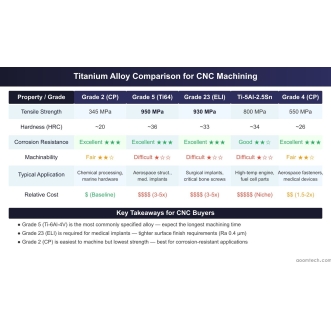
Titanium dominates aerospace for its exceptional strength-to-weight ratio. Used in landing gear, engine mounts, and hydraulic systems. Requires low cutting speeds (40-80 SFM) and plenty of coolant.
Inconel 718 (Nickel Superalloy)
Inconel 718 maintains strength at temperatures up to 700 degrees C. Used for turbine discs, blades, and exhaust components. Requires ceramic or coated carbide inserts and rigid setups.
Stainless Steel 17-4 PH
17-4 PH offers high strength and corrosion resistance. Used for actuator components, fasteners, and structural brackets.
Tolerance Requirements for Aerospace Parts
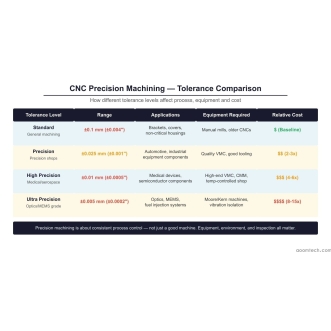
Aerospace tolerances are tighter than almost any other industry. Turbine blades require +/-0.0025 mm. Landing gear +/-0.010 mm. Hydraulic fittings +/-0.005 mm. These require temperature-controlled machining and CMM inspection.
| Component | Tolerance | Ra Finish |
|---|---|---|
| Turbine Blades | +/-0.0025 mm | 0.1-0.2 um |
| Landing Gear | +/-0.010 mm | 0.4-0.8 um |
| Hydraulic Fittings | +/-0.005 mm | 0.2-0.4 um |
| Engine Mounts | +/-0.025 mm | 0.4 um |
| Structural Brackets | +/-0.050 mm | 0.8-1.6 um |
AS9100 and AS9102 Requirements
AS9100 is the quality management standard for aerospace. Key requirements include risk management, configuration management, counterfeit parts prevention, special process control (NADCAP), and AS9102 first article inspection.
First Article Inspection per AS9102 verifies every dimension against the engineering drawing. Full material traceability is required from heat lot to finished part.
Surface Finish and Design Tips
Surface finish affects fatigue life. For rotating components, Ra 0.2 um or better is standard. Design tips include using radiused corners, avoiding thin walls below 0.5 mm, and specifying GD&T per ASME Y14.5.
- Avoid sharp internal corners - use radiused corners
- Deep pockets need reduced tool overhang and peck milling
- Aerospace uses UNJF and MJ thread forms with controlled root radius
- True position tolerancing per ASME Y14.5 is standard
Final Thoughts
CNC machining for aerospace is one of the most demanding applications. The materials are tough, tolerances are tight, and certification requirements are extensive. AOOM Technology follows AS9100-compliant processes for every order. Contact us for your aerospace CNC machining needs.
 CNC Machining for Aerospace: M
CNC Machining for Medical Devi
CNC Machining for Aerospace: M
CNC Machining for Medical Devi
 CNC Precision Machining Parts:
 CNC Machining Titanium: Alloys