


CNC Machining vs 3D Printing: Which Technology Is Right for Your Project?
You have a part to make. One shop recommends CNC machining. Another says 3D printing is faster and cheaper. Who's right? The answer depends on geometry, volume, material, tolerance, and budget — and getting it wrong costs real money. Here's a practical comparison of CNC machining vs 3D printing to help you decide.
When CNC Machining Wins
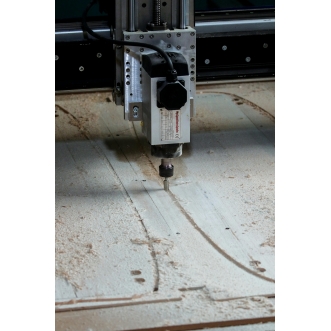
CNC is the right choice when you need tight tolerances, production-grade materials, or quantity. If your part needs ±0.01mm accuracy, needs to be made from 7075 aluminum or 316 stainless, and you're making 100+ units, CNC is the way to go. The setup cost is amortized across the run, and every part after the first is consistent.
CNC also wins on surface finish. A machined part comes off the machine at Ra 1.6 µm or better. 3D printed parts typically need sanding, vapor smoothing, or machining to achieve the same finish. For visible parts or sealing surfaces, CNC is the standard.
Material properties are another factor. CNC parts have the same strength as the raw material — no layer lines, no weak axis. For structural components, this matters.
When 3D Printing Wins
3D printing excels at complex geometries that CNC can't produce. Internal cooling channels, lattice structures for weight reduction, organic shapes for ergonomic handles — these are additive-only capabilities. If your design has features that would require multiple CNC setups or EDM, 3D printing might save both time and money.
For prototypes, 3D printing is hard to beat. A part that would take a week to program, fixture, and machine on a CNC can often be printed overnight. That speed lets you iterate faster. I've seen product development cycles cut from months to weeks by using 3D printed prototypes before committing to CNC production.
3D printing also shines for custom or low-volume parts. One-off medical implants, custom jigs and fixtures, replacement parts for obsolete equipment — these don't justify the setup cost of CNC machining.
When to Use Both
Some of the best approaches combine both technologies. Print a complex near-net-shape part, then finish critical surfaces with CNC machining. This hybrid approach gives you the geometric freedom of 3D printing with the precision and surface finish of CNC.
I've quoted jobs where the customer printed a prototype, tested it, then transitioned to CNC for production once the design was locked. That's a smart strategy — validate with additive, produce with subtractive.
Cost Comparison: Real Numbers
Let me give you a real example. A simple aluminum bracket — 50mm x 30mm x 10mm with four mounting holes.
CNC machining: Program time 30 min, setup 15 min, cycle time 8 min per part. Total for 10 parts: ~$250 ($25/part). Total for 500 parts: ~$1,750 ($3.50/part). Setup cost spread across volume makes CNC cheap at scale.
3D printing (SLS nylon): No programming cost, 4 hours print time. Total for 10 parts: ~$150 ($15/part). Total for 500 parts: ~$7,500 ($15/part — no volume discount because each part takes the same machine time).
The crossover point where CNC becomes cheaper than 3D printing varies — typically between 50 and 500 units depending on part complexity and material. For most metal parts, CNC wins at any quantity above single prototypes.
My Take
Don't treat this as an either/or decision. Use 3D printing to validate your design quickly. Use CNC for production parts that need tight tolerances, real material properties, and consistent quality. And consider hybrid approaches — 3D print near-net-shape, CNC finish the critical features.
At AOOM Technology, we specialize in CNC machining for production-grade parts. But we also work with customers who start with 3D printed prototypes and transition to CNC for production. If you're not sure which approach is right for your project, send us your drawing. We'll give you a straight answer — and if 3D printing is better for your prototype, we'll tell you that too. Contact AOOM today.
 CNC Machining vs 3D Printing:
 CNC Machining for Aerospace: A
 CNC Machining for Medical Devi
 CNC Machining DFM: A Practical