

CNC Mold Processing and Mold Repair Precautions
Introduction to CNC Mold Processing and Mold Repair
CNC mold processing plays a vital role in modern manufacturing. It is widely used to produce high-precision molds for industries such as automotive, electronics, medical devices, and plastic products. These molds directly affect the accuracy, appearance, and performance of final products.
At the same time, mold repair is equally important. Even high-quality molds wear out or get damaged after long-term production. Proper repair helps extend mold life, reduce production costs, and avoid unexpected downtime on the production line. For example, a well-maintained injection mold can continue producing consistent plastic parts for years, while a poorly maintained mold may cause defects or stop production entirely.
This article explains key CNC Mold Processing and Mold Repair Precautions to help manufacturers improve quality, reduce risks, and ensure stable production performance.
Importance of CNC Mold Processing and Repair
CNC mold processing ensures that molds are manufactured with high precision and repeatability. This is essential because even a small machining error can lead to defective mass-produced parts. In industries like automotive or electronics, such errors may cause serious quality issues.
Mold repair, on the other hand, provides a cost-effective way to restore damaged molds instead of replacing them completely. This significantly reduces manufacturing expenses and improves production efficiency. Timely repair also prevents small issues from turning into major failures.
Precautions in CNC Mold Processing
Pre-processing Considerations
Design Review
A thorough design review is one of the most important pre-processing precautions in CNC mold processing. Before machining begins, the mold design should be carefully analyzed to ensure it is suitable for CNC manufacturing.
Engineers should check for:
Sharp internal corners that may be difficult to machine
Deep undercuts that require special tooling or multi-axis machining
Thin walls that may deform during processing
Using CAD/CAM simulation helps identify potential machining problems in advance. Design optimization techniques such as adding fillets, increasing draft angles, and simplifying complex geometries can greatly improve machining efficiency and reduce tool wear.
Material Selection
Choosing the correct mold material is essential for performance and durability. Different materials have different machining characteristics and applications:
P20 steel: Commonly used for general plastic molds with good machinability
H13 steel: Suitable for high-temperature and high-pressure applications
Aluminum alloys: Ideal for rapid prototyping and low-volume production due to lightweight and easy machining
Material selection should be based on production volume, mold lifespan, and working conditions such as temperature and pressure.
Machining Process Precautions
Tooling Selection
Tooling precautions in CNC mold machining are critical for achieving high precision and surface quality. Carbide cutting tools are commonly used because of their hardness and wear resistance.
Key considerations include:
Tool geometry (rake angle, clearance angle, helix angle)
Tool coating for improved wear resistance
Matching tool type with mold material
Regular tool inspection is also necessary. Worn tools can lead to poor surface finish, dimensional errors, and even tool breakage.
Fixturing and Workpiece Alignment
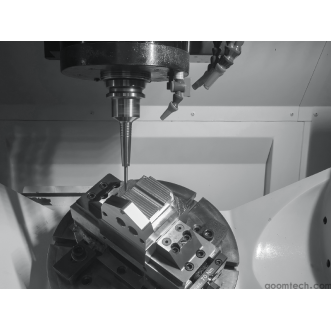
A stable fixturing system ensures that the mold remains fixed during machining. Any movement can cause serious dimensional errors.
Common fixturing solutions include hydraulic clamps, magnetic chucks, and custom fixtures designed for specific mold shapes. Proper alignment with CNC machine axes must be checked before machining starts to ensure accuracy.
Machining Parameters
Correct machining parameter selection directly affects quality and tool life. Parameters such as spindle speed, feed rate, and cutting depth must be optimized based on material and operation type.
For example:
High spindle speed for rough cutting to remove material quickly
Lower speed and fine feed for finishing to achieve smooth surface quality
Incorrect parameter settings may cause overheating, tool wear, or even workpiece damage.
Quality Control During Processing
In-process Inspection
In-process inspection is an essential step in CNC mold production. It ensures that errors are detected early before they become costly problems.
Inspection tools such as calipers, micrometers, and coordinate measuring machines (CMMs) are used to check:
Cavity depth accuracy
Flatness of mold surfaces
Hole roundness and position accuracy
Regular inspection improves consistency and ensures the final mold meets design specifications.
Precautions in Mold Repair
Damage Assessment
Accurate damage assessment in mold repair is the foundation of successful restoration. The mold must be carefully inspected to identify wear, cracks, corrosion, or breakage.
Non-destructive testing methods such as ultrasonic testing and magnetic particle inspection are often used to detect internal defects that are not visible on the surface.
A correct assessment helps determine whether the mold can be repaired and what repair method should be used.
Repair Method Selection
Choosing the right repair method depends on the type and severity of damage. Common methods include:
Welding repair: Used for cracks or broken areas
CNC re-machining: Used to restore dimensional accuracy
Surface coating: Used to improve wear and corrosion resistance
The selected method should match the mold material and ensure long-term durability after repair.
Post-repair Treatment
After repair, molds often require additional treatment to restore their performance. Heat treatment may be applied to recover hardness and strength, especially for steel molds. Surface treatments such as nitriding or coating can further improve wear resistance.
Proper post-repair processing ensures the mold can safely return to production without performance issues.
Quality Assurance After Repair
After repair, a final inspection must be carried out to confirm that the mold meets original specifications. This includes checking dimensions, surface finish, and functional performance.
If any deviation is found, further adjustment or rework is necessary before the mold is put back into production.
Common Mistakes to Avoid in CNC Mold Processing and Repair
Neglecting Design Optimization
Ignoring design optimization can lead to unnecessary machining difficulties. Poor designs may cause tool interference, long machining times, or inaccurate final dimensions. This increases both cost and production risk.
Improper Tooling and Parameter Setting
Incorrect tooling or machining parameters can significantly affect mold quality. Problems such as poor surface finish, excessive tool wear, or tool breakage are often caused by improper settings.
Inadequate Damage Assessment in Repair
If damage is not properly evaluated, the wrong repair method may be chosen. This can result in repeated failures or even further damage to the mold, reducing its service life.
Conclusion
Understanding CNC Mold Processing and Mold Repair Precautions is essential for achieving high-quality manufacturing results. From design review and material selection to tooling setup, machining control, and repair strategies, each step plays a critical role in mold performance and lifespan.
By following proper engineering practices and avoiding common mistakes, manufacturers can improve production efficiency, reduce costs, and ensure long-term reliability of molds used in industrial production.
 Process of Custom High-Precisi
 CNC Machining Parameter Settin
 5 Key Tips for CNC Machining o
 Small-batch Precision Parts 5-