


CNC Machining for Consumer Electronics: Precision Parts for Enclosures, Heat Sinks & Connectors
Your smartphone metal frame, a laptop heat sink, a wireless earbud charging contacts, a smartwatch case — these are all CNC machined. Consumer electronics is one of the largest industries for precision CNC machining, yet it is often overlooked in favor of aerospace and medical.
The electronics industry demands tight tolerances (±0.02mm or better), high-volume repeatability, and materials that balance thermal performance with cost. If you are designing electronics enclosures, heat sinks, connectors, or structural components for consumer devices, here is what you need to know.
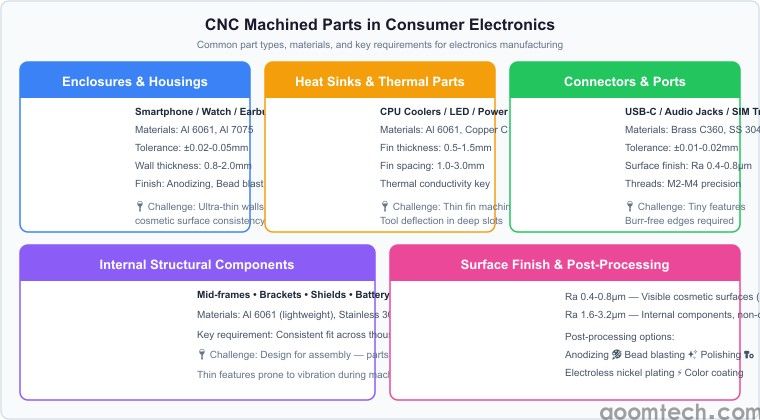
Common CNC Machined Parts in Consumer Electronics
Not all electronics parts are PCBs and chips. The physical structure — the frame, casing, thermal management — relies heavily on CNC machining.
Enclosures and Housings — Smartphones, tablets, smartwatches, and earphones all use CNC-machined metal frames. Aluminum 6061 and 7075 are most common. The trend toward ultra-thin designs (sub-5mm) pushes machining tolerances to the limit.
Heat Sinks and Thermal Management — CNC-machined heat sinks from aluminum 6061 or copper offer the best thermal conductivity. Thin fins (0.5-1.0mm) with tight spacing maximize surface area.
Connectors and Ports — USB-C ports, audio jacks, SIM trays, charging contacts — these small, precision features are often CNC machined from brass or stainless steel.
Internal Structural Components — Mid-frames, brackets, shields, and support structures inside electronic devices.
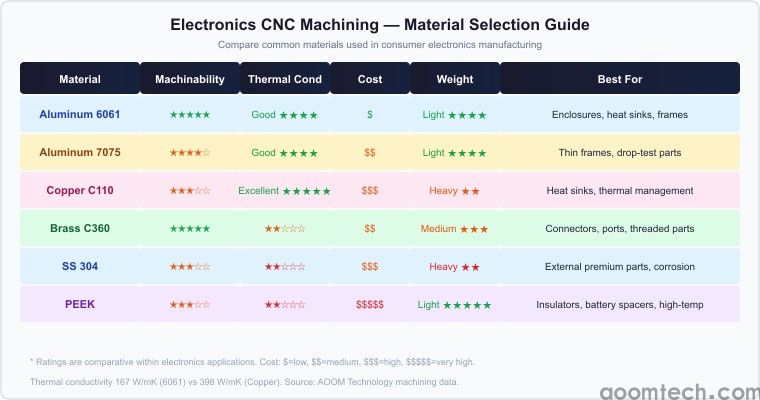
Materials for Electronics CNC Machining
Material selection in electronics is different from other industries. Thermal and electrical properties matter as much as mechanical strength.
Aluminum 6061 is the workhorse. Good thermal conductivity (167 W/mK), excellent machinability, lightweight, and cost-effective.
Copper C110 is the gold standard for heat sinks. Its thermal conductivity (398 W/mK) is more than double aluminum. But it is heavy, expensive, and gummy to machine.
Brass C360 is for connectors, contacts, and threaded features. Best machinability of any metal.
Tolerance Requirements in Electronics
Consumer electronics tolerances are tighter than most people think. A smartphone frame might have ±0.02mm on critical fit surfaces. Thin walls (sub-1mm) and cosmetic surface finish requirements are often tighter than functional tolerances.
Surface Finish for Electronics Parts
For visible surfaces, Ra 0.4-0.8µm is typical. Post-processing is common: anodizing, bead blasting, polishing, electroless nickel plating.
Volume Considerations
Consumer electronics is almost always high-volume — thousands to hundreds of thousands of parts per year. A custom fixture that costs $2,000 might reduce cycle time by 30 seconds per part — at 50,000 parts, that is a net saving of $12,000 in machine time.
My Take on Electronics CNC Machining
The electronics industry moves fast. Product cycles are 12-18 months. Working with a CNC shop that understands consumer electronics matters — they will know what questions to ask about surface finish, cosmetic requirements, and thermal management.
At AOOM Technology, we machine precision parts for consumer electronics — from aluminum smartphone frames to copper heat sinks to brass connectors. Upload your design and we will provide a quote with DFM feedback specific to electronics manufacturing.
 CNC Machining for Consumer Ele
 CNC Machining Cost Reduction:
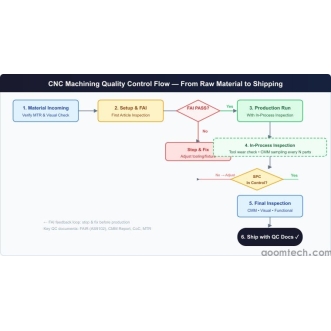 CNC Machining Quality Control:
 CNC Machining for Aerospace: A