


How Does a High-Precision CNC Machining Factory Guarantee ±.01mm Accuracy?
How Does a High-Precision CNC Machining Factory Guarantee ±0.01mm Accuracy?
In modern manufacturing, many industries such as aerospace, medical devices, automotive, and electronics require extremely tight tolerances. One of the most common questions is: How Does a High-Precision CNC Machining Factory Guarantee ±0.01mm Accuracy?
Achieving ±0.01mm accuracy is not the result of a single factor. It is a complete system that combines advanced equipment, strict process control, skilled people, and a stable environment. Below we explain the key methods used in high-precision CNC machining factories.
Advanced Equipment and Regular Calibration
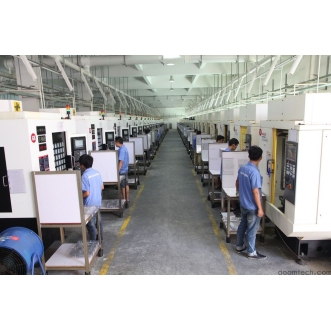
High-precision CNC machining factories rely on advanced equipment for ±0.01mm accuracy in CNC machining. These machines are not ordinary CNC systems. They are high-end models equipped with high-resolution servo motors, rigid machine structures, and advanced CNC controllers.
The linear guideways, ball screws, and spindle systems are manufactured with extremely tight tolerances. This ensures smooth movement and very low positioning error during machining.
However, even the best machine will drift over time. That is why regular calibration is essential. Factories use precision instruments such as laser interferometers to measure axis movement accuracy. Any small deviation caused by wear, temperature change, or vibration is corrected immediately.
For example, if a machine has a positioning error of just 0.005mm on each axis and it is not corrected, the final part error can easily exceed ±0.01mm, especially on complex geometries. Regular calibration prevents this accumulation of error.
High-Quality Tooling and Tool Management
Another key factor is tooling for high-precision CNC machining. Cutting tools directly affect the final dimension and surface quality of parts.
Factories use premium carbide tools with advanced coatings such as TiAlN or DLC. These coatings reduce friction, improve wear resistance, and minimize heat buildup during cutting. Lower heat means less thermal expansion of the tool, which improves dimensional stability.
Tool wear is carefully monitored. Modern factories use tool monitoring systems that track cutting force, vibration, and spindle load. When a tool starts to wear, it is replaced before it affects part accuracy.
For example, a worn end mill may produce parts that are 0.02mm undersized or oversized due to edge degradation and deflection. In high-precision work, this is unacceptable, so proactive tool replacement is required.
Skilled Workforce and Continuous Training
Even with advanced machines, human expertise remains critical. Skilled engineers and operators are essential for maintaining ±0.01mm accuracy.
Programmers use CAD/CAM software to create precise toolpaths. They carefully consider material type, cutting strategy, and tolerance requirements when designing machining programs.
Operators are responsible for machine setup. They ensure correct fixture alignment, proper tool installation, and accurate workpiece positioning.
For example, a skilled operator may notice slight tool deflection during a trial cut and adjust feed rate or cutting depth in real time. This quick decision prevents tolerance deviation and ensures consistent quality.
Factories also invest in continuous training so staff stay updated with the latest CNC technologies and precision machining methods.
Quality Control and Inspection Processes
Quality control in high-precision CNC factories is not done only at the end. It is integrated throughout the entire production process.
During machining, in-process inspection is performed using coordinate measuring machines (CMMs). These machines measure part geometry with micron-level precision. If any deviation is detected early, adjustments are made immediately.
For example, if a hole diameter is found to be 0.008mm larger than tolerance during inspection, the machining parameters are corrected before the next part is produced. This prevents waste and ensures batch consistency.
After machining, final inspection includes dimensional checks, surface roughness testing, and sometimes non-destructive testing such as ultrasonic inspection to detect internal defects.
Controlled Machining Environment
Environmental stability is another key factor in achieving ±0.01mm accuracy. Even small changes in temperature or vibration can affect machining results.
High-precision factories use temperature-controlled workshops where conditions are kept within a narrow range, often around 20°C ±1°C. This prevents thermal expansion of machines, tools, and workpieces.
Machines are also installed on vibration-isolation foundations. Anti-vibration pads and reinforced floors help reduce external disturbances caused by nearby equipment or traffic.
For example, a temperature increase of just 2°C can cause measurable expansion in metal workpieces, leading to dimensional errors. With proper environmental control, this risk is greatly reduced.
Conclusion
So, How Does a High-Precision CNC Machining Factory Guarantee ±0.01mm Accuracy? The answer lies in a complete system approach:
Advanced CNC machines with ultra-low positioning error
Regular calibration using laser measurement systems
High-quality tooling and strict tool management
Skilled engineers and continuous training
Comprehensive quality control in high-precision CNC factories
Stable, controlled machining environments
When all these elements work together, achieving ±0.01mm accuracy becomes a controlled and repeatable process, not a matter of chance. This is what separates high-precision CNC machining factories from standard machining workshops.
EEAT Note: The practices described above are based on widely accepted CNC manufacturing standards used in precision engineering industries such as ISO-based quality systems, metrology principles, and industrial machining best practices.
 How to Ensure Precision in CNC
 Small Batch Precision CNC Mach
 What surface finish can CNC ma
 CNC Machining Tolerance Settin