5-Axis CNC Machining Services
Introduction to 5 - Axis CNC Machining Services
5 - Axis CNC Machining Services refer to advanced manufacturing processes that use computer-controlled machines capable of moving a cutting tool or workpiece along five different axes at the same time. This allows manufacturers to create highly complex and precise parts in a single setup.
The significance of 5 - axis CNC machining has grown rapidly in modern industry. It has revolutionized manufacturing by offering high precision, improved flexibility, and faster production. Parts that once required multiple machines and several setups can now be completed in one continuous process. This technology is widely used in aerospace, automotive, medical, and other high-precision industries.
The Significance of 5 - Axis CNC Machining
5 - axis CNC machining has changed how complex parts are designed and produced. By reducing the need for multiple setups, it improves accuracy and reduces production time. This also lowers the risk of human error and improves overall product quality.
Industries such as aerospace rely heavily on this technology for critical components like turbine blades and structural parts. The automotive and medical industries also benefit from its ability to produce detailed and customized parts efficiently.
Benefits of 5 - Axis CNC Machining Services
Enhanced Precision
One of the key benefits of 5 - axis CNC machining services is extremely high precision. The machine can move along multiple axes simultaneously, allowing it to achieve tight tolerances.
For example, aerospace turbine blades require perfect aerodynamic shapes. 5 - axis CNC machining can produce these complex contours with high accuracy, improving engine efficiency and performance.
Complex Geometry Machining
5 - axis machining makes it possible to create highly complex geometries that are difficult or impossible with traditional methods. This includes free-form surfaces, deep cavities, and internal channels.
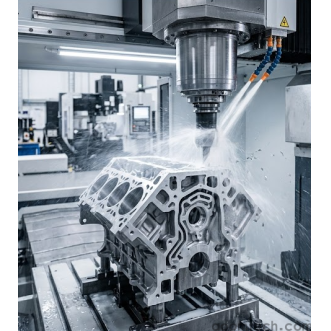
In the automotive industry, engine components with complex cooling channels can be manufactured efficiently. In the medical field, custom implants shaped to match a patient’s anatomy can be produced with high precision using 5 - axis technology.
Reduced Setup Time
Another major advantage is reduced setup time. Since machining can be performed from multiple angles in a single setup, there is no need to reposition the part repeatedly.
For example, in large industrial mold production, reducing setup time significantly increases productivity and reduces production costs while maintaining accuracy.
Process of 5 - Axis CNC Machining
Design and CAD/CAM Programming
The process of 5 - axis CNC machining begins with CAD (Computer-Aided Design), where engineers create a detailed 3D model of the part. This model includes all functional and geometric requirements.
Next, CAM (Computer-Aided Manufacturing) software converts the design into machine instructions. Toolpaths are carefully planned to control movement along five axes. Cutting speed, feed rate, and spindle speed are also defined. For example, a complex jewelry design with multiple angles requires careful programming to ensure smooth tool movement and accurate detailing.
Material Selection and Preparation
Choosing the right material is critical. Different materials such as aluminum, titanium, or stainless steel behave differently during machining. Harder materials may require stronger tools and slower cutting speeds.
Before machining, materials are cut to size, inspected, and sometimes heat-treated to improve strength and durability. Proper preparation ensures stable machining and high-quality results.
Machining Operations
Milling
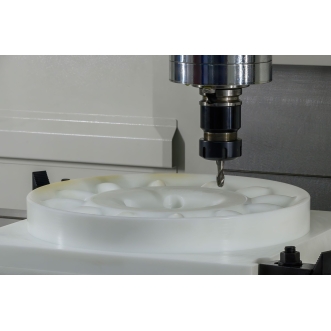
Milling is the most common operation in 5 - axis machining. The cutting tool moves across the workpiece from different angles to create complex surfaces. Tools such as ball-nose mills and end mills are used depending on the shape and finish required.
Careful adjustment of cutting speed and feed rate ensures smooth surface quality and accurate dimensions.
Turning (if applicable)
For cylindrical parts, turning operations may be used. The workpiece rotates while the tool moves along multiple axes, allowing for advanced shaping and contouring.
This is useful for components that require high concentricity and smooth surface finishes.
Drilling and Boring (if applicable)
Drilling and boring operations are used to create precise holes. With 5 - axis movement, hole placement becomes more accurate, even on angled or curved surfaces.
Proper coolant usage and controlled feed pressure help maintain hole quality and tool life.
Finishing Operations
After machining, finishing processes improve the final part quality. These may include polishing, deburring, and coating.
For example, applying a protective coating such as hard chrome improves wear resistance and extends the lifespan of mechanical components.
Applications of 5 - Axis CNC Machining Services
Aerospace Industry
The applications of 5 - axis CNC machining services in aerospace are extensive. Components such as turbine blades, engine housings, and structural parts require high precision and complex shapes.
For example, a lightweight wing spar produced using 5 - axis machining improves aircraft performance and reduces fuel consumption.
Automotive Industry
In the automotive industry, 5 - axis machining is used for engine parts, transmission systems, and custom body components.
A high-performance engine block manufactured using this technology can improve power output and efficiency while maintaining durability.
Medical Industry
The medical field uses 5 - axis machining for surgical tools, dental implants, and orthopedic devices.
A custom dental implant designed to match a patient’s jaw structure can significantly improve comfort, function, and long-term oral health.
Challenges in 5 - Axis CNC Machining Services
Complex Programming
One of the main challenges in 5 - axis CNC machining services is programming complexity. Coordinating five axes requires advanced software and skilled operators.
A small programming error can lead to tool collisions, damaging both the machine and the workpiece.
Tool and Workpiece Setup
Proper setup is critical. Misalignment can cause dimensional errors and reduce part quality.
For example, incorrect alignment during machining may result in parts being out of tolerance and needing to be scrapped.
Costs
5 - axis CNC machining services are generally more expensive due to advanced equipment and skilled labor requirements.
However, companies often balance costs by reducing production steps and improving efficiency.
Choosing a 5 - Axis CNC Machining Service Provider
Experience and Expertise
When choosing a 5 - axis CNC machining service provider, experience is very important. An experienced provider understands complex machining challenges and material behavior.
For example, an experienced aerospace machining provider can solve difficult tolerance issues that less experienced companies may struggle with.
Quality Assurance
A strong quality control system ensures consistent results. This includes in-process inspection, final testing, and use of calibrated measuring tools.
A reliable provider will detect defects before delivery, preventing costly failures in final applications.
Cost-effectiveness
Cost is also an important factor. While 5 - axis machining can be expensive, competitive providers offer better value through efficiency and optimized processes.
Ordering in bulk or standardizing designs can help reduce overall costs.
Conclusion: Making the Most of 5 - Axis CNC Machining Services
5 - Axis CNC Machining Services provide advanced capabilities for producing highly complex and precise parts across multiple industries. They offer benefits such as improved accuracy, reduced setup time, and the ability to manufacture complex geometries.
However, challenges such as programming complexity, setup accuracy, and cost must also be considered. By carefully selecting a qualified service provider with strong experience and quality systems, businesses can fully benefit from this advanced manufacturing technology.
Understanding these key factors helps manufacturers make better decisions and achieve higher performance in modern production environments.
RELATED PRODUCTS
-
Medical Brass CNC Machining Parts
-
Precision CNC Machining PEEK Services
-
Precision Custom CNC Machined Car Parts
-
cnc machining optical housings
-
Precision CNC Casting Machining Services
-
Precision Gear CNC Machining Services
-
Precision Stainless Steel Parts CNC Mach
-
CNC Machining of Precision Aluminum Tube
-
CNC Machining of Large Precision Aluminu
-
CNC Machining & Manufacturing of Pre