5-Axis CNC Machining
5 - Axis CNC Machining is an advanced manufacturing technology that has changed how complex parts are made. It is widely used in industries that require high precision, smooth surface quality, and complex shapes. Compared with traditional 3-axis machining, it adds two extra rotational movements, allowing tools to reach the workpiece from many directions.
The significance of 5 - axis CNC machining lies in its ability to produce highly detailed and accurate components in a more efficient way. It has transformed production in aerospace, automotive, medical, and many other industries by reducing production time and improving part quality.
Significance of 5 - Axis CNC Machining
Enhanced Precision and Complexity
5 - Axis CNC Machining allows manufacturers to create parts with extremely high precision and complex shapes. The cutting tool can move along three linear axes (X, Y, Z) and rotate along two additional axes. This makes it possible to machine difficult geometries in a single process.
For example, in the aerospace industry, turbine blades require very precise contours to ensure efficient airflow and performance. With 5-axis machining, these blades can be shaped accurately from multiple angles without repeated repositioning.
Reduced Setup and Production Time
One of the key advantages highlighted in the significance of 5 - axis CNC machining is reduced setup time. Parts that would normally require several setups in 3-axis machining can often be completed in a single setup.
For instance, a complex mold that once required multiple repositioning steps can now be machined in one operation. This reduces production time by nearly half and improves overall manufacturing efficiency.
How 5 - Axis CNC Machining Works
Axis Movements and Coordination
To understand how 5 - axis CNC machining works, it is important to know its five movement directions. These include:
X-axis: left and right movement
Y-axis: forward and backward movement
Z-axis: up and down movement
A-axis: rotation around X-axis
B/C-axis: rotation around Y or Z-axis
These axes work together to position the cutting tool or the workpiece at almost any angle. For example, the tool can tilt and rotate to reach hidden surfaces or create angled cuts without manual adjustment.
CAD/CAM Programming
The process starts with CAD (Computer-Aided Design), where a 3D model of the part is created. Then CAM (Computer-Aided Manufacturing) software generates the machining instructions.
For example, when producing a complex aerospace bracket, engineers design the part in CAD software. The CAM system then converts it into a detailed 5-axis toolpath. One challenge is ensuring smooth tool movement without collisions, which is solved using advanced simulation and optimization tools.
Benefits of 5 - Axis CNC Machining
Improved Surface Finish
One major advantage in the benefits of 5 - axis CNC machining is improved surface quality. Because the tool can approach the surface from the best possible angle, cutting becomes smoother and more consistent.
For example, high-end automotive engine parts produced with 5-axis machining often require little or no additional polishing, saving time and cost.
Greater Design Freedom
5 - Axis CNC Machining allows engineers to design highly complex and organic shapes that are difficult or impossible with traditional machining methods.
For instance, modern architectural components with curved, free-form surfaces can be manufactured accurately, enabling innovative building designs.
Cost-effectiveness in the Long Run
Although machines using 5 - Axis CNC Machining have higher initial costs, they often reduce total production costs over time. This is due to fewer setups, lower error rates, and faster production cycles.
For example, a manufacturing company producing precision parts may reduce overall costs significantly after switching from 3-axis to 5-axis machining for high-volume production.
Applications of 5 - Axis CNC Machining
Aerospace Industry
In aerospace, applications of 5 - axis CNC machining include turbine blades, engine casings, and structural components. These parts require extreme precision and reliability.
For example, turbine blades must withstand high temperatures and pressure. 5-axis machining ensures accurate geometry, which improves engine efficiency and safety.
Automotive Industry
The automotive industry uses 5-axis machining for engine components, transmission parts, and custom fixtures. It helps improve performance, durability, and fuel efficiency.
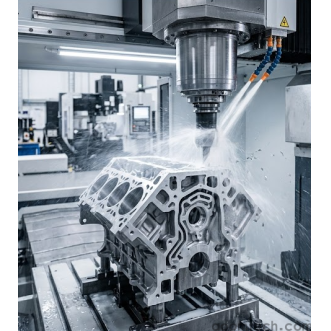
For example, complex engine blocks can be machined more efficiently, reducing production time while maintaining high precision.
Medical Industry
In the medical field, applications of 5 - axis CNC machining include surgical tools, dental implants, and custom medical devices. Precision is critical in these applications.
For example, a dental implant must fit perfectly into a patient’s jaw structure. 5-axis machining ensures the exact shape and smooth finish needed for safe and effective use.
Challenges in 5 - Axis CNC Machining
Programming Complexity
One of the main challenges in 5 - axis CNC machining is programming difficulty. The additional axes require precise coordination to avoid errors.
For example, a small programming mistake in toolpath calculation can lead to incorrect cutting or surface damage. This is usually fixed through simulation and careful debugging.
Tool Wear and Collision Risks
Because the tool moves in many directions, there is a higher risk of wear and collision. Proper planning is essential to avoid damage.
For example, collision detection software is often used to simulate machining before actual production, helping prevent expensive machine or tool damage.
Operator Skill Requirements
Operating 5-axis machines requires experienced technicians. They must understand machine movement, programming logic, and troubleshooting techniques.
For example, inexperienced operators may struggle with setup errors, but proper training and hands-on experience can significantly improve accuracy and efficiency.
Conclusion: Harnessing the Power of 5 - Axis CNC Machining
5 - Axis CNC Machining is a powerful technology that improves precision, reduces production time, and enables complex part design. Its significance in modern manufacturing continues to grow across industries such as aerospace, automotive, and medical.
Understanding how 5 - axis CNC machining works, along with its benefits, applications, and challenges, helps businesses make better production decisions.
As manufacturing continues to evolve, companies are encouraged to explore how 5-axis technology can improve efficiency, reduce costs, and expand design possibilities in their production processes.
RELATED PRODUCTS
-
Medical Brass CNC Machining Parts
-
Precision CNC Machining PEEK Services
-
Precision Custom CNC Machined Car Parts
-
cnc machining optical housings
-
Precision CNC Casting Machining Services
-
Precision Gear CNC Machining Services
-
Precision Stainless Steel Parts CNC Mach
-
CNC Machining of Precision Aluminum Tube
-
CNC Machining of Large Precision Aluminu
-
CNC Machining & Manufacturing of Pre