


Which manufacturer excels at mass CNC machining of parts
Which Manufacturer Excels at Mass CNC Machining of Parts
In modern manufacturing, mass CNC machining of parts plays a critical role in industries such as automotive, aerospace, medical devices, robotics, and consumer electronics. Companies often depend on high-volume CNC production to ensure consistent quality, fast delivery, and cost efficiency.
However, a common challenge for businesses is answering the question: Which manufacturer excels at mass CNC machining of parts? The answer is not simple, because the best choice depends on production needs, quality expectations, budget, and engineering complexity. This article explains how to evaluate manufacturers, compares real-world examples, and provides a structured approach to making the right decision.
The Significance of Finding the Right Manufacturer
Choosing the right CNC machining manufacturer is not just a procurement decision—it directly impacts product performance and business success.
For example, in the automotive industry, a poorly managed CNC supplier can cause delays in engine component delivery, leading to production bottlenecks and costly assembly line stoppages. In consumer electronics, inconsistent machining tolerances can result in defective enclosures or connectors, increasing return rates and damaging brand reputation.
A reliable mass CNC machining partner ensures:
Stable and repeatable part quality
Efficient large-scale production capacity
Reduced long-term manufacturing costs
On-time delivery for global supply chains
Factors to Evaluate Manufacturers for Mass CNC Machining
Production Capacity
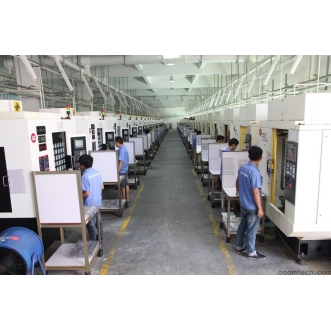
Production capacity is one of the most important factors to evaluate mass CNC machining manufacturers. A strong manufacturer typically operates hundreds of CNC machines, including 3-axis, 4-axis, and 5-axis machining centers.
Key indicators include:
Number of CNC machines and automation systems
Facility size and production layout efficiency
Shift schedules (24/7 operation capability)
A high-capacity manufacturer can support large-scale orders for industries like consumer electronics, where millions of identical components may be required monthly.
Quality Control Measures
Strict quality control is essential for mass production. Even small deviations can lead to large-scale product failures.
Leading manufacturers implement:
In-process inspection using coordinate measuring machines (CMM)
Final product testing and statistical sampling
Quality certifications such as ISO 9001 or IATF 16949
Effective quality systems ensure defects are detected early, preventing wasted production runs and reducing scrap costs.
Experience and Expertise
Experience directly influences manufacturing reliability. A manufacturer with years of expertise in specific industries understands material behavior, tolerances, and finishing requirements.
For example, aerospace CNC machining requires strict tolerance control and advanced materials such as titanium and Inconel. An experienced supplier in this field will already have validated processes for such demanding requirements.
Cost-effectiveness
Cost should be evaluated beyond unit price. A low-cost supplier may introduce hidden expenses such as rework, delays, or inconsistent quality.
To evaluate cost-effectiveness:
Compare multiple supplier quotations
Assess tooling and setup costs for mass production
Consider long-term partnership pricing models
The best manufacturers balance affordability with consistent quality and efficiency.
Flexibility and Adaptability
Mass production environments often change quickly. A strong CNC manufacturer must be flexible enough to adjust production volumes, materials, or design updates.
For example, if a client increases order volume by 30% or modifies a part design mid-cycle, the manufacturer should be able to adapt without significant downtime or quality issues.
Case Studies of Manufacturers Excelling at Mass CNC Machining
Case Study 1: Large-Scale Automotive CNC Supplier (Tier-1 Example)
This manufacturer specializes in high-volume machining of engine blocks, transmission components, and suspension parts for global automotive brands.
Key strengths:
Operates over 300 CNC machining centers with automated pallet systems
Integrated quality system with real-time CMM monitoring
Strong capability in aluminum and steel high-volume machining
Analysis: This supplier excels in production capacity and process stability. Their automation systems reduce human error and ensure consistent output across millions of parts. However, their customization flexibility is limited due to highly standardized production lines.
Case Study 2: Precision Industrial CNC Manufacturer (Mid-to-High Mix Production)
This manufacturer focuses on aerospace components, industrial machinery parts, and precision medical device components.
Key strengths:
Advanced 5-axis machining capability for complex geometries
Strong engineering support for prototyping and scaling to mass production
High emphasis on tight tolerances and material traceability
Comparison: Compared to the automotive-focused supplier, this manufacturer offers greater flexibility and precision but has slightly lower mass-production throughput. It is better suited for industries requiring both complexity and medium-to-high volume production.
How to Compare and Choose the Best Manufacturer
Create a Comparison Matrix
A structured comparison is one of the most effective methods for comparing mass CNC machining manufacturers. A comparison matrix helps visualize strengths and weaknesses clearly.
Example structure:
Production Capacity
Quality Control
Industry Experience
Cost Efficiency
Flexibility
By assigning ratings or notes to each category, businesses can quickly identify the most suitable partner. For example, one manufacturer may score highest in production capacity but lower in flexibility, while another may offer the opposite balance.
Request Samples and References
Before final selection, requesting samples is essential. Physical samples help evaluate:
Dimensional accuracy and tolerances
Surface finishing quality
Material strength and consistency
In addition, customer references provide insight into real-world performance, including communication speed, delivery reliability, and problem-solving ability.
Conclusion: Selecting the Ideal Manufacturer for Mass CNC Machining
Understanding Which manufacturer excels at mass CNC machining of parts requires evaluating multiple factors rather than focusing on a single metric. Production capacity, quality control systems, industry expertise, cost efficiency, and adaptability all play essential roles in supplier selection.
Through structured evaluation methods, including comparison matrices and sample testing, businesses can significantly reduce production risks and improve long-term manufacturing stability.
Key takeaway: The best CNC machining manufacturer is not always the largest or cheapest—it is the one that best aligns with your production scale, quality expectations, and engineering requirements.
For long-term success, companies should maintain active communication with their manufacturing partners, continuously evaluate performance, and stay informed about advances in CNC technology and automation.
 How to Ensure Precision in CNC
 Small Batch Precision CNC Mach
 What surface finish can CNC ma
 CNC Machining Tolerance Settin