


How Does CNC Machine Parts? Complete Process Explained
From CAD File to Finished Part
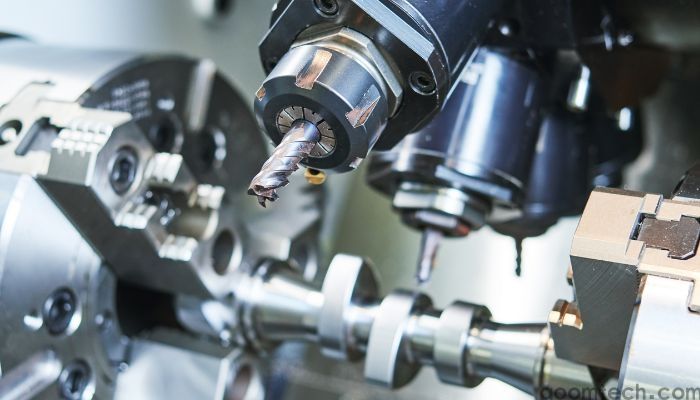
A lot of engineers ask me: what actually happens inside the CNC machine? They see the cutting action, but the real work starts long before the spindle turns. At AOOM, we follow a repeatable process that turns raw material into precision parts. Here's how it works in our shop.
Step One: Design Review and CAM Programming
Every job starts with a CAD file. Our engineers look at the 3D model and check for manufacturability issues — thin walls that will chatter, sharp internal corners that need smaller tools, features that cause clearance problems. We flag these before we write a single line of code. Then we load the model into CAM software like Mastercam or Fusion 360 and generate tool paths. This is where we decide cutting tools, spindle speeds, feed rates, and coolant strategy for every operation.
I always tell clients: a good CAM program is the difference between a part that looks machined and a part that looks molded. Tool path strategy matters that much.
Step Two: Machine Setup
We mount the workpiece on the correct fixturing — precision vises for prismatic parts, vacuum tables for thin sheets, or custom jigs for complex geometries. Then we load the tooling into the automatic tool changer. Our Mazak and DMG Mori 5-axis machines can hold 40 to 60 tools in one setup. That means most parts are finished in a single cycle. No re-fixturing, no accumulated error.
A first-article run verifies everything. We measure the first part completely before production begins. If dimensions are off, we adjust the program right then. This saves material and time.
Step Three: Machining Operations
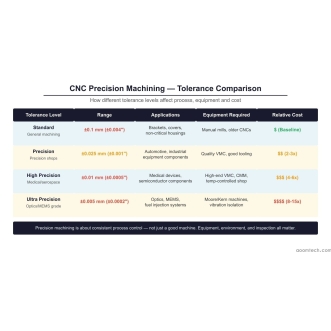
The machine executes three phases. Roughing removes the bulk material — fast passes, heavy chip loads, no need for surface quality. Semi-finishing brings the part closer to final dimensions. Finishing achieves the final geometry and surface finish. We run finishing passes at lower speeds with light radial engagement. For aluminum, we hold ±0.005 mm easily. For steels and titanium, ±0.01 mm is our standard.
Secondary operations like drilling, tapping, and boring happen in the same setup whenever possible. That keeps cycle times down and eliminates transfer errors.
Step Four: Quality Control
Every part goes through inspection. We use CMMs for dimensional verification, optical comparators for profile checks, and surface roughness testers for finish quality. Results are documented and traceable back to the production batch. If a part doesn't meet spec, it doesn't ship.
Send your CAD files to chen@aoomtech.com for a quote within 24 hours.
 CNC Machining for Defense and
 CNC Machining for Aerospace: M
CNC Machining for Medical Devi
CNC Machining for Aerospace: M
CNC Machining for Medical Devi
 CNC Precision Machining Parts: