


CNC Machining Technology for Precision Automotive Molds
Why Automotive Molds Need Precision CNC
Automotive molds are among the most demanding work we do at AOOM. The parts these molds produce — dashboards, bumpers, engine components, lighting housings — need to fit perfectly across thousands of cycles. A mold that's off by 0.01mm produces parts that are off by 0.01mm, and in automotive assembly, that gap shows.
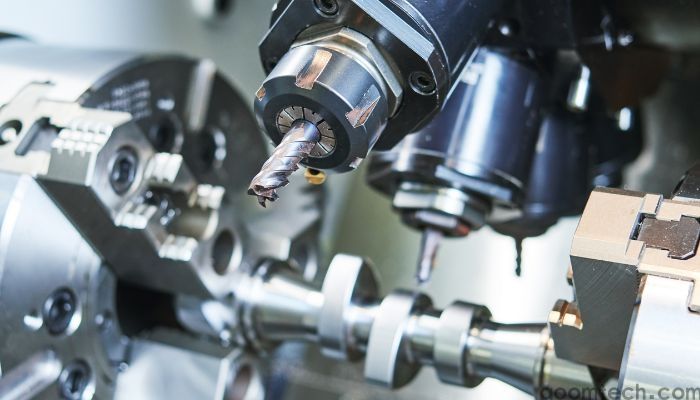
We see this in our shop regularly. An automotive Tier 1 supplier sends us a mold insert for a bumper bracket. The print calls for ±0.02mm on cavity dimensions and Ra 0.4μm on the molding surface. That's tight — but it's standard for visible automotive parts that go straight to assembly without secondary finishing.
Our Automotive Mold Process
Every automotive mold job follows a structured path. We start with 3D modeling and machining simulation. Our CAM software simulates the full toolpath — roughing, semi-finishing, and finishing — and detects collisions before metal is cut. This is critical on complex molds with deep cavities where tool holder clearance is minimal.
Roughing removes the bulk of material quickly. On H13 tool steel, we run indexable carbide cutters with high feed rates. Heat treatment takes the steel to 48-52 HRC. Then finishing with small-diameter ball end mills at high RPM produces the final surface. For features that can't be milled — sharp internal corners, deep slots — we use EDM (electrical discharge machining).
Grinding follows for flat mating surfaces. We hold flatness within 0.005mm across the parting line. That prevents flash in the molded part and extends mold life.
Material Selection for Automotive Molds
P20 is our standard recommendation for prototype and low-volume automotive molds. It machines well and has good polishability. H13 is the most common production mold steel — it resists thermal fatigue and wear from repeated heating cycles. S7 tool steel works best for dies that see impact loading. For high-volume production molds exceeding 500,000 cycles, we recommend pre-hardened stainless grades like 420SS.
Quality Assurance
Every mold we ship gets a full inspection report. CMM measurement on critical cavity dimensions. Surface roughness verification. Hardness testing. Fit checks on slides, lifters, and core pins. We document everything because automotive OEMs audit their supply chain, and traceability matters.
Our automotive mold processing capabilities include molds for injection molding, compression molding, and die casting. We work with client tooling engineers from design review through mold tryout.
Send your CAD files to chen@aoomtech.com for a quote within 24 hours.
 CNC Machining for Defense and
 CNC Machining for Aerospace: M
CNC Machining for Medical Devi
CNC Machining for Aerospace: M
CNC Machining for Medical Devi
 CNC Precision Machining Parts: