


CNC Machining Process for Molds
The CNC Machining Process for Molds is a key part of modern manufacturing. It allows companies to produce highly precise and durable molds used in mass production. These molds are essential for shaping materials such as plastics, metals, and ceramics into consistent and accurate parts. From automotive components to consumer product housings, mold quality directly affects the final product quality.
Importance of Molds in Manufacturing
Molds are the foundation of many manufacturing processes. They are used to form identical parts in large volumes, ensuring consistency, efficiency, and cost control.
For example:
In plastic injection molding, molds are used to produce smartphone cases, bottles, and household items.
In the automotive industry, molds create dashboards, engine covers, and interior plastic parts.
In electronics, molds form connectors, housings, and insulation components.
Without high-quality molds, it is impossible to achieve stable mass production. That is why precision in mold manufacturing is extremely important.
Pre-Machining Considerations for Mold CNC Machining
Design and Engineering
One of the most important pre-machining considerations for mold CNC machining is design accuracy. Engineers use CAD (Computer-Aided Design) software to build a detailed 3D model of the mold before production begins.
A good mold design must include:
Draft angles – to ensure easy removal of molded parts
Cooling channels – to control temperature during production
Parting lines – to define how the mold splits
Cavity and core structure – to shape the final product
Design optimization is important. While complex shapes may be required, unnecessary complexity should be reduced to improve machining efficiency and reduce cost.
Material Selection
Choosing the right material is another critical step in the CNC Machining Process for Molds. Different materials affect machining performance, mold life, and production cost.
Common mold materials include:
P20 steel – widely used for plastic injection molds, good balance of hardness and machinability
H13 steel – high strength and heat resistance, suitable for high-volume production
Aluminum – lightweight and easy to machine, ideal for prototyping or low-volume production
Beryllium copper – excellent thermal conductivity for efficient cooling
Material selection depends on production volume, required durability, cost budget, and type of molded material. For example, high-volume automotive production typically uses hardened steel, while prototype molds often use aluminum for faster turnaround.
CNC Machining Operations for Molds
Milling in Mold CNC Process
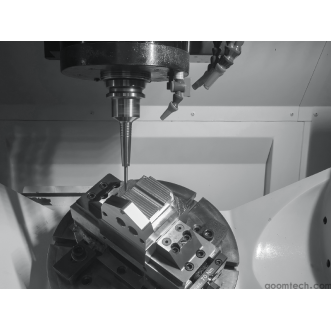
Milling in mold CNC process is the core operation used to shape the mold body. CNC milling machines remove material layer by layer to create cavities, cores, and complex surfaces.
There are two main types of milling:
Rough milling – removes large amounts of material quickly
Finish milling – produces smooth surfaces and high accuracy
Carbide end mills are commonly used due to their durability and wear resistance. Machining parameters such as spindle speed, feed rate, and cutting depth must be carefully controlled.
For example:
Higher speed and feed rate are used for rough cutting
Lower speed and finer feed are used for surface finishing
Proper toolpath programming is also essential. CAM software is used to generate optimized toolpaths that reduce machining time and improve surface quality.
EDM (Electrical Discharge Machining)
EDM is used when shapes are too complex for traditional cutting tools. It is especially useful for sharp corners, deep cavities, and fine details.
There are two main types:
Sinker EDM – uses a shaped electrode to erode material
Wire EDM – uses a thin wire to cut through metal with high precision
EDM requires careful control of electrical parameters and proper flushing to remove debris. This process is slower than milling but provides extremely high accuracy.
Drilling and Boring Operations
Drilling is used to create holes for ejector pins, cooling channels, and fasteners. Boring is used to refine and enlarge holes to precise dimensions.
To ensure accuracy:
Use peck drilling to avoid chip buildup
Apply coolant to reduce heat and tool wear
Use precise positioning systems or drill guides
These operations ensure that all internal features of the mold function correctly during production.
Tooling and Fixturing for Mold CNC Machining
Tool Selection
Tool selection plays a major role in machining quality and efficiency. In mold manufacturing, carbide tools are widely used due to their hardness and long tool life.
Important tool factors include:
Tool geometry (rake angle, clearance angle, helix angle)
Coating type for wear resistance
Tool diameter and length for accessibility
Regular inspection and replacement of tools is necessary to maintain precision and avoid defects in the mold surface.
Fixturing Design
A stable fixturing system is essential for accuracy. Molds are often heavy and complex, so secure clamping is required during machining.
Common fixturing solutions include:
Hydraulic clamps for strong and stable holding
Magnetic chucks for flat steel components
Custom modular fixtures for complex shapes
Proper alignment between the fixture and CNC machine axes ensures dimensional accuracy throughout the machining process.
Quality Control in Mold CNC Machining
In-Process Inspection
Quality control in mold CNC machining begins during production. In-process inspection helps detect errors early and prevent costly rework.
Common inspection tools include:
Coordinate Measuring Machines (CMM)
Micrometers and calipers
Surface roughness testers
Key inspection points include cavity depth, hole diameter, and surface finish quality. If deviations are found, machining parameters can be adjusted immediately.
Final Inspection
After machining is completed, a full inspection is performed. This ensures the mold meets all design specifications.
Final checks include:
Dimensional accuracy verification
Surface finish evaluation
Functional testing (e.g., part ejection and cooling efficiency)
Only molds that pass all tests are approved for production use.
Post-Machining Processes for Molds
Heat Treatment
Heat treatment improves mold performance by enhancing hardness, strength, and wear resistance. Common processes include quenching, tempering, and annealing.
The choice of treatment depends on material type and intended usage. For example, H13 steel molds often undergo quenching and tempering to withstand high-temperature production environments.
Surface Treatment
Surface treatment improves durability and performance. It also extends mold life and enhances product quality.
Common methods include:
Chrome plating – improves corrosion resistance and reduces friction
Nitriding – increases surface hardness
Coatings – improve wear resistance and release performance
Selecting the right surface treatment depends on production conditions and material compatibility.
Conclusion
The CNC Machining Process for Molds is a highly precise and structured workflow that combines engineering design, material selection, advanced machining operations, and strict quality control. Each step directly affects the final mold performance, durability, and production efficiency.
By understanding key areas such as pre-machining considerations for mold CNC machining, milling in mold CNC process, and quality control in mold CNC machining, manufacturers can produce high-quality molds that support stable and efficient mass production across industries.
A well-executed mold machining process not only improves product quality but also reduces long-term manufacturing costs and increases competitiveness in the global market.
 Process of Custom High-Precisi
 CNC Machining Parameter Settin
 5 Key Tips for CNC Machining o
 Small-batch Precision Parts 5-