


CNC Machining Small Parts
CNC Machining Small Parts is a highly precise manufacturing process used to produce miniature components with tight tolerances and complex features. These parts are essential in modern industries where performance, accuracy, and reliability are critical. From electronics to medical devices, small parts often determine the success of the final product.
Introduction to CNC Machining Small Parts
plays a key role in producing components that are too small or too complex for conventional machining methods. Even though these parts are tiny, their importance is significant across many industries.
Importance of Small Parts in Various Industries
Small parts are widely used in industries that demand high precision and reliability:
Electronics: micro-connectors, resistors, semiconductor housings, and integrated circuit packages.
Medical field: insulin pump components, surgical instruments, dental implants, and diagnostic devices.
Aerospace: miniature fasteners, sensor housings, and control system components.
Automotive: fuel injection system parts, sensor housings, and precision connectors.
Even the smallest deviation in these components can affect the performance of the entire system, making precision manufacturing extremely important.
Pre-machining Considerations for Small Parts
Design Optimization
Proper design is one of the most important steps in pre-machining for CNC small part machining. Small components must be designed with machining limitations in mind.
Key design considerations include:
Avoid overly complex geometries that may be difficult to machine at a micro scale.
Maintain consistent wall thickness to reduce deformation risk.
Use standard feature sizes whenever possible to reduce machining errors.
Apply CAD/CAM simulation to detect potential issues before production.
By simplifying unnecessary complexity, manufacturers can improve accuracy without sacrificing functionality.
Material Selection
Choosing the right material is essential for successful machining and part performance. Different applications require different material properties.
Common material choices include:
Metals: copper and aluminum for electronics due to good electrical conductivity.
Titanium: widely used in medical applications because of its biocompatibility and strength.
Stainless steel: offers corrosion resistance and durability.
Engineering plastics: used in lightweight and insulating components.
Material properties directly influence cutting force, tool wear, and potential deformation during machining. Selecting the right material ensures better machinability and performance.
CNC Machining Operations for Small Parts
Milling Operations
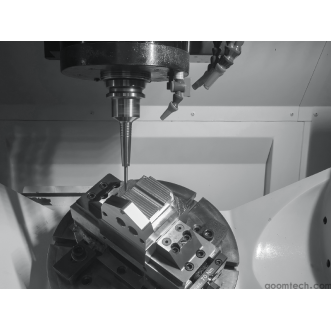
Milling operations in CNC small part machining are commonly used to create slots, pockets, and complex 3D shapes. Micro-milling uses extremely small cutting tools to achieve high precision.
Important factors include:
High spindle speeds for improved surface finish.
Controlled feed rate to prevent tool damage.
Shallow depth of cut to reduce tool stress.
Toolpath planning in CAD/CAM systems is essential to ensure accuracy and avoid collisions. High-quality micro-tools must also be used to maintain precision.
Turning Operations (If Applicable)
For cylindrical small parts, micro-turning is used to machine external and internal diameters.
Key setup considerations include:
Precise alignment of the workpiece and tool.
Proper spindle speed and feed rate selection.
Effective coolant application to prevent overheating.
Drilling and Boring
Micro-drilling is required when small parts need precise holes. These operations must be carefully controlled to avoid tool breakage and dimensional errors.
Best practices include:
Using peck drilling to improve chip removal.
Selecting specialized micro-drill bits for accuracy.
Maintaining proper alignment to ensure correct hole positioning.
Tooling and Fixturing for Small Parts
Micro-tool Selection
Micro-tools are essential in CNC machining small parts due to their precision and small size. Carbide tools are commonly used because of their hardness and wear resistance.
Important selection factors include:
Tool geometry (rake angle, clearance angle, flute design).
Material compatibility.
Tool size and rigidity.
Proper storage and handling are also important to avoid tool damage.
Fixturing for Small Parts
Stable fixturing is critical because even slight movement can cause machining errors. Traditional fixtures may not be suitable for miniature components.
Common solutions include:
Vacuum chucks for flat and thin parts.
Magnetic fixtures for ferromagnetic materials.
Custom micro-fixtures for complex geometries.
Accurate alignment ensures repeatability and precision in production.
Quality Control in CNC Machining of Small Parts
In-process Inspection
Quality control in CNC-machined small parts begins during production. Continuous inspection helps detect errors early and reduce waste.
Common inspection methods include:
Micro-calipers for dimensional checks.
Microscopes for surface evaluation.
High-precision optical measurement systems.
Key inspection points include slot width, hole diameter, and surface roughness.
Final Inspection and Testing
After machining, each part undergoes final inspection to ensure compliance with specifications.
Testing may include:
Dimensional accuracy verification.
Surface finish analysis.
Functional testing such as electrical conductivity or mechanical fit.
Non-conforming parts are either reworked or rejected based on quality standards.
Challenges and Solutions in CNC Machining Small Parts
Tool Wear and Breakage
Micro-tools are more sensitive to wear and breakage due to their small size and high-speed operation. This is a major challenge in precision manufacturing.
Solutions include:
Using advanced coatings to improve tool life.
Selecting appropriate tool materials for specific applications.
Optimizing cutting parameters to reduce stress.
Thermal Effects
Heat generation can cause dimensional errors in small components due to thermal expansion.
To reduce thermal effects:
Use effective coolant systems.
Reduce excessive cutting speeds when necessary.
Allow cooling time between machining cycles.
Conclusion
CNC machining small parts requires careful attention to design, material selection, tooling, and quality control. Because of their size, even small errors can significantly affect performance. By following proper pre-machining for CNC small part machining strategies, optimizing milling operations in CNC small part machining, and maintaining strict quality control in CNC-machined small parts, manufacturers can achieve high precision, reliability, and consistency.
With the right approach, CNC technology continues to enable the production of highly complex and miniature components that power modern industries.
 Process of Custom High-Precisi
 CNC Machining Parameter Settin
 5 Key Tips for CNC Machining o
 Small-batch Precision Parts 5-