


CNC Milling Technology for Precision Parts and Its Applications
CNC Milling Technology for Precision Parts and Its Applications is a core topic in modern manufacturing. It explains how computer-controlled milling machines produce highly accurate and complex components used in critical industries. Today, many products we use every day depend on precision parts made by CNC milling, from aircraft engines to medical tools and electronic devices.
Introduction to CNC Milling Technology for Precision Parts
The Significance of CNC Milling for Precision Parts
CNC (Computer Numerical Control) milling technology for precision parts is an advanced manufacturing process that uses computer programming to control cutting tools. This technology is important because it allows manufacturers to produce parts with very tight tolerances, complex shapes, and consistent quality.
Precision parts are required in industries where even a small error can cause serious problems. For example, in the aerospace industry, engine components must work under extreme pressure and temperature. In the medical field, surgical instruments and implants must fit the human body perfectly. In electronics, small and accurate components ensure devices function properly and safely.
Without CNC milling, producing such precise components would be slow, expensive, and less reliable.
Details of CNC Milling Technology for Precision Parts
CNC Milling Machines for Precision Parts
Different types of CNC milling machines for precision parts are used depending on the complexity and size of the workpiece:
Vertical CNC Milling Machines: The spindle is positioned vertically. These machines are widely used for flat surfaces and simple 3D parts. They are cost-effective and suitable for general precision machining tasks.
Horizontal CNC Milling Machines: The spindle is horizontal, allowing better chip removal and stability. They are often used for heavy cutting and large parts.
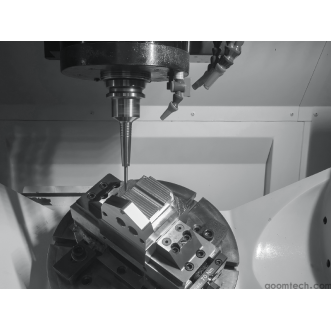
Five-Axis CNC Milling Machines: These advanced machines can move the cutting tool and workpiece in five directions simultaneously. They are ideal for producing highly complex shapes such as turbine blades or medical implants in a single setup.
The selection of machine type depends on the geometry, material, and accuracy requirements of the precision part.
Cutting Tools
Cutting tools are essential in CNC milling because they directly affect accuracy, surface finish, and production efficiency. Common tools include:
End Mills: Used for general cutting and shaping operations.
Ball Nose Mills: Used for smooth 3D contouring and curved surfaces.
Face Mills: Used for flat surface machining and material removal.
Most cutting tools are made from carbide due to its hardness, heat resistance, and durability. In some cases, coated tools are used to improve tool life and performance.
Tool selection depends on the workpiece material (such as aluminum, steel, or titanium), required surface finish, and machining conditions.
CNC Programming
CNC programming is the brain of the machining process. Engineers use CAD/CAM (Computer-Aided Design and Computer-Aided Manufacturing) software to design the part and generate toolpaths.
The program controls important machining parameters such as:
Tool movement paths
Spindle speed
Feed rate
Depth of cut
Accurate programming is critical. Even a small error in code can lead to incorrect dimensions, poor surface quality, or tool damage. This is why simulation and verification are important steps before actual machining begins.
Applications of CNC Milling Technology for Precision Parts
Aerospace Industry
In aerospace, applications of CNC milling in aerospace are extremely important. CNC milling is used to manufacture turbine blades, engine casings, structural frames, and landing gear components.
These parts must withstand high stress, extreme temperatures, and continuous vibration. CNC milling ensures tight tolerances and high reliability. Materials such as titanium alloys and high-strength steels are commonly used because of their strength-to-weight ratio and heat resistance.
Five-axis machining is often used in aerospace manufacturing to create complex geometries in a single setup, improving accuracy and reducing production time.
Medical Industry
In the medical field, CNC milling is used to produce surgical instruments, orthopedic implants, and medical device components.
Precision is critical because these parts directly affect human health. Implants must match the patient’s anatomy exactly to ensure comfort and safety. Surgical tools must be sharp, accurate, and reliable.
Biocompatible materials such as stainless steel, titanium, and medical-grade polymers are commonly used. Strict quality control standards such as ISO 13485 are often applied in medical manufacturing to ensure safety and compliance.
Electronics Industry
In the electronics industry, CNC milling is used to manufacture heat sinks, electronic enclosures, PCB fixtures, and connectors.
Modern electronics require miniaturization and high performance. CNC milling helps achieve precise dimensions and fine surface finishes needed for compact designs.
For example, aluminum is commonly used for heat sinks because of its excellent thermal conductivity. Accurate machining ensures efficient heat dissipation, which improves device performance and lifespan.
Ensuring High-Quality Results in CNC Milling of Precision Parts
Quality Control Measures
Quality control is a key part of ensuring quality in CNC milling of precision parts. It ensures that every part meets design specifications and industry standards.
Common inspection tools include:
Calipers and micrometers for dimensional measurement
Surface roughness testers for evaluating finish quality
Coordinate Measuring Machines (CMMs) for high-precision inspection
In-process inspection is also important. It helps detect issues such as tool wear or dimensional drift early. Final inspection ensures the finished part meets all requirements before delivery.
Process Optimization
Process optimization improves efficiency, reduces cost, and enhances quality. Manufacturers continuously analyze production data such as machining time, tool wear, and defect rates.
Based on this data, adjustments can be made, such as:
Optimizing toolpaths to reduce machining time
Adjusting cutting speed and feed rate
Improving machining sequences
This continuous improvement approach helps maintain consistent quality and productivity in CNC milling operations.
Operator Training
Skilled operators are essential for successful CNC milling operations. Even with advanced automation, human expertise plays a key role in setup, monitoring, and quality control.
Operators should be trained in:
CNC programming and machine operation
Material properties and machining behavior
Tool selection and maintenance
Quality inspection methods
Well-trained operators reduce errors, improve efficiency, and ensure stable production quality.
Conclusion
CNC Milling Technology for Precision Parts and Its Applications plays a vital role in modern manufacturing. It enables the production of highly accurate and complex components used in aerospace, medical, and electronics industries.
By understanding CNC milling machines for precision parts, selecting proper cutting tools, using accurate CNC programming, and applying strict quality control, manufacturers can achieve excellent results.
As industries continue to demand higher precision and better performance, CNC milling will remain a key technology driving innovation, efficiency, and product reliability worldwide.
 Process of Custom High-Precisi
 CNC Machining Parameter Settin
 5 Key Tips for CNC Machining o
 Small-batch Precision Parts 5-