


How to Customize Small-Batch CNC Machining of Cavity Parts
Small-batch production of cavity parts plays an essential role in modern manufacturing, especially when companies need fast iteration, custom designs, or limited production runs. Understanding How to Customize Small-Batch CNC Machining of Cavity Parts helps engineers, designers, and manufacturers achieve better accuracy, lower cost, and faster delivery while maintaining high performance standards.
Introduction to Customizing Small-Batch CNC Machining of Cavity Parts
Significance of Cavity Parts in Small-Batch Production
Cavity parts are widely used in industries where precise hollow or molded structures are required. They are commonly found in injection molds, die-casting dies, aerospace housings, and precision industrial tooling.
In small-batch production, cavity parts are especially important because they allow manufacturers to quickly test new product designs or produce limited quantities without investing in large-scale tooling systems. This is essential for startups and R&D teams that need flexibility and speed.
For example, a startup developing a new consumer plastic product may rely on a custom injection mold cavity to produce only a few hundred test units before moving into mass production. Similarly, aerospace companies often require custom cavity parts for specialized lightweight structural components used in prototypes or limited aircraft models.
Part Design for Customization
Understand the Requirements (part design for small-batch cavity part CNC machining)
The first step in customization is understanding the full requirements of the cavity part. This includes:
Functional purpose of the part
Material it will contact or interact with
Load, pressure, and temperature conditions
Surface finish requirements
Ejection or assembly method (if used in molds)
For injection mold cavities, engineers must consider how molten plastic flows into the cavity, how it cools, and how the final part is released. These factors directly affect mold performance and product quality.
To gather accurate requirements, engineers should work closely with clients through technical drawings, CAD models, and functional discussions. Using tools like Computer-Aided Design (CAD) systems ensures that expectations are clearly defined before machining begins.
Optimize Design for Machining
Design optimization is a critical step in reducing machining time and cost. Complex geometries may look ideal in theory, but they often increase production difficulty in CNC machining.
Key optimization strategies include:
Adding draft angles for easier part release from molds
Replacing sharp internal corners with rounded fillets
Ensuring smooth transitions between surfaces
Avoiding deep, narrow cavities where possible
For example, replacing a sharp 90-degree internal corner with a radius allows better tool access and reduces tool wear. This also improves surface finish and extends tool life during machining.
Material Selection for Cavity Parts
Match Material to Application (material selection in customizing small-batch cavity parts)
Choosing the right material is essential for performance, durability, and cost efficiency. Different applications require different material properties.
Common materials include:
P20 steel – commonly used for injection mold cavities due to good machinability and moderate hardness
H13 tool steel – ideal for high-temperature and high-wear applications
Aluminum alloys – used for lightweight molds and fast heat dissipation
For instance, aluminum is often chosen for prototype molds because it allows faster machining and shorter cooling cycles. However, for long production runs, tool steels like H13 are preferred due to higher wear resistance.
Consider Material Availability and Cost
In small-batch CNC machining, material availability can directly impact project timelines. Even the best material is not useful if it causes delays or exceeds budget limits.
Manufacturers should balance:
Material performance requirements
Availability from suppliers
Total project cost constraints
A practical strategy is to evaluate alternative materials with similar properties. For example, if a high-grade alloy is too expensive, a mid-range tool steel may provide sufficient performance at a lower cost.
CNC Machining Processes for Cavity Parts
Milling Operations
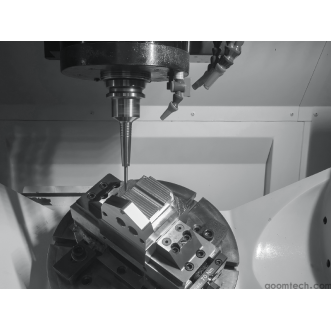
Milling is the most common process used in cavity machining. It involves removing material using rotating cutting tools.
Common tools include:
End mills – used for pockets, slots, and detailed geometry
Ball nose mills – ideal for curved surfaces and 3D contours
Face mills – used for flat surface roughing and finishing
Key machining parameters include spindle speed, feed rate, and depth of cut. These must be optimized based on material type and cavity geometry.
For example, harder steels require lower spindle speeds but higher cutting forces, while aluminum allows higher speeds and faster material removal rates.
EDM (Electrical Discharge Machining) (if applicable)
Electrical Discharge Machining (EDM) is used when traditional cutting tools cannot reach complex internal features or extremely hard materials are involved.
EDM works by using controlled electrical sparks to erode material from the workpiece. It is widely used in precision cavity manufacturing for sharp details, deep cavities, and hardened steels.
Key setup factors include:
Electrode material selection (e.g., copper or graphite)
Discharge energy settings
Pulse duration and frequency control
While EDM offers excellent precision, it is slower than milling and generally used for finishing or complex geometry areas.
Tooling and Fixturing for Small-Batch Cavity Parts
Select Appropriate Tools
Tool selection directly affects surface quality, machining speed, and tool life. High-quality coated tools are especially important in cavity machining.
For example, carbide end mills with TiAlN coatings improve heat resistance and reduce wear when machining hardened steel materials.
Tool selection should consider:
Material hardness
Surface finish requirements
Geometry complexity
Design Fixturing for Stability
Stable fixturing ensures that the workpiece remains fixed during machining, preventing vibration and dimensional errors.
Common fixturing solutions include:
Vacuum chucks for flat or thin parts
Magnetic chucks for steel components
Custom mechanical clamps for complex shapes
In small-batch production, modular fixtures are especially useful because they can be adjusted for different part designs without requiring full redesigns.
Quality Control in Small-Batch Cavity Part Machining
In-Process Inspection (quality control for small-batch CNC-machined cavity parts)
Quality control must begin during machining, not after production is complete. In-process inspection helps detect issues early and reduce scrap rates.
Key inspection tools include:
Calipers and micrometers for dimensional checks
Coordinate Measuring Machines (CMM) for high-precision geometry validation
Surface roughness testers for finish evaluation
Common inspection points include cavity depth, wall thickness, flatness, and corner radii accuracy.
Final Inspection and Testing
After machining is complete, a full inspection ensures the cavity part meets all specifications.
This includes:
Final dimensional verification
Surface quality assessment
Functional testing under simulated working conditions
For example, a cavity used in fluid-handling components may undergo pressure testing to ensure there are no leaks or deformation issues.
If a part fails inspection, engineers may adjust machining parameters, redesign problematic features, or refine tool selection for future batches.
Conclusion
Understanding How to Customize Small-Batch CNC Machining of Cavity Parts is essential for achieving high precision, efficiency, and cost control in modern manufacturing. From design optimization and material selection to machining processes and quality control, each step plays a critical role in production success.
By applying proper engineering principles and focusing on practical manufacturing constraints, companies can improve product quality while maintaining flexibility for small-batch production needs. This approach ensures better performance, faster development cycles, and more reliable cavity part manufacturing outcomes.
 Process of Custom High-Precisi
 CNC Machining Parameter Settin
 5 Key Tips for CNC Machining o
 Small-batch Precision Parts 5-