


Price of Mold CNC Machining
Introduction to the Price of Mold CNC Machining
Importance of Understanding Pricing - Understanding the Price of Mold CNC Machining is very important for companies and individuals involved in mold making and product manufacturing. It helps with accurate budgeting, better negotiation with suppliers, and avoiding unexpected cost increases during production.
For example, if a company underestimates the cost of a mold, the project may exceed its budget and be stopped halfway. In some cases, buyers choose a low-cost provider and receive poor-quality molds that fail during production, leading to more losses in the long run.
Material-related Price Factors
Different Mold Materials and Their Costs
The type of material used is one of the most important material-based price factors in mold CNC machining. Common materials include:
Ordinary steel (45# steel, P20) - Lower cost, good machinability. Approximate range: $1.5 - $3.5 per kg.
Alloy tool steel (H13, Cr12MoV) - Higher strength and heat resistance. Approximate range: $3 - $8 per kg.
High-speed steel - Used for high-wear molds. Approximate range: $8 - $20 per kg.
Cemented carbide - Extremely hard and wear-resistant but expensive. Can exceed $30 per kg or more.
Harder and more wear-resistant materials increase machining difficulty, tool wear, and processing time, which raises overall cost.
Material Quality and Grade
Material quality also affects pricing. Higher-grade steels have fewer impurities, more stable chemical composition, and better performance in long-term mold use. For example, premium-grade H13 steel provides better heat resistance and durability than standard grades, but it costs more.
To balance cost and performance, buyers should choose material grades based on mold lifespan, production volume, and operating conditions.
Machining Process-related Price Factors
CNC Machining Operations
The Price of Mold CNC Machining is strongly affected by machining processes such as milling, turning, drilling, and EDM (Electrical Discharge Machining).
Milling - Used for shaping mold cavities. Cost varies depending on complexity, typically $30 - $120 per hour.
Turning - Used for cylindrical parts. Usually faster and lower cost, around $25 - $80 per hour.
Drilling - Simple operation but increases cost when precision is required.
EDM - Used for complex shapes and deep cavities. High precision but slow, often $60 - $150 per hour.
Complex geometries increase machining time, tool usage, and programming effort, which directly increases cost.
Precision Requirements and Tolerances
Tight tolerances significantly increase cost. A mold requiring ±0.01mm precision needs slower machining speeds, advanced measurement tools, and more inspection steps compared to a ±0.1mm tolerance mold.
High-precision molds are necessary for industries like medical devices and electronics, while general industrial molds can use looser tolerances to reduce cost.
Batch-size and Quantity-related Price Factors
Economies of Scale
Batch production reduces the per-unit cost due to batch-size impact on mold CNC machining cost. Fixed costs such as programming, setup, and tooling are shared across multiple molds.
For example, producing 10 identical molds may reduce the cost per mold by 20%–40% compared to producing only one unit.
Single-piece and Small-batch Costs
Single molds or small batches are more expensive because setup and programming costs are not spread across many units. This increases the cost per part significantly.
To reduce cost, customers can:
Combine multiple projects into one production batch
Negotiate shared setup costs with suppliers
Standardize mold designs when possible
Equipment and Labor-related Price Factors
Equipment Type and Capabilities
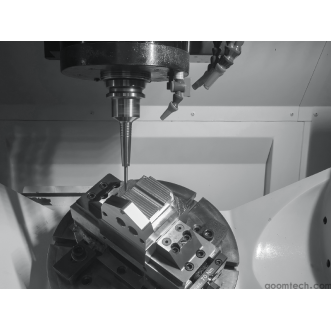
Equipment-related pricing in mold CNC machining depends on machine type and capability. High-end machines such as five-axis CNC machining centers are more expensive but can produce complex molds in fewer setups.
Typical machine cost impact:
3-axis CNC: lower cost, suitable for simple molds
4-axis CNC: medium cost, better flexibility
5-axis CNC: highest cost, ideal for complex geometries and high precision
More advanced machines reduce production time but increase hourly rates.
Labor Costs
Skilled labor is another major cost factor. CNC programmers, engineers, and machine operators with advanced skills are required for mold manufacturing.
Labor costs vary by region. In high-cost regions, hourly labor may be $20–$80 or more, while lower-cost regions may be significantly cheaper. Experience level and technical skill also directly affect pricing.
Other Price-influencing Factors
Design Complexity
Molds with complex structures such as deep cavities, thin walls, or undercuts require more machining time and advanced programming. This increases both cost and production difficulty.
Complex designs may also require special tools and multiple machine setups, increasing the total Price of Mold CNC Machining.
Additional Services and Post-machining Processes
Extra processes can significantly affect cost, including:
Heat treatment - Improves hardness and durability
Surface finishing - Polishing or coating for better performance and appearance
Quality inspection - Using CMM and precision measuring tools
These services improve mold performance but may increase total cost by 10%–30% depending on requirements.
Conclusion
The Price of Mold CNC Machining depends on many factors, including material type, machining processes, precision requirements, batch size, equipment capabilities, labor, and design complexity.
By understanding these factors and planning carefully, buyers can make smarter decisions, control costs, and achieve better manufacturing results without sacrificing quality.
 Process of Custom High-Precisi
 CNC Machining Parameter Settin
 5 Key Tips for CNC Machining o
 Small-batch Precision Parts 5-