Elevator Parts CNC Machining
Elevator Parts CNC Machining
Elevator Parts CNC Machining plays a critical role in the modern elevator industry by ensuring that every mechanical and structural component is manufactured with high accuracy, safety, and consistency. Elevators are widely used in residential buildings, commercial towers, hospitals, and industrial facilities, and their reliability depends heavily on the quality of each part inside the system.
From car frames to guide rails and control housings, CNC machining helps produce elevator parts that meet strict engineering and safety requirements. This article explains what elevator parts CNC machining is, why it matters, how it is done, what materials are used, the main challenges, and how to choose the right manufacturing partner.
The Significance of Elevator Parts
Elevator systems are composed of many interconnected components, each responsible for safe and smooth vertical transportation. Even a small defect in one part can affect performance or safety.
Key elevator parts include:
Car frames – support the elevator cabin and ensure passenger safety
Guide rails – control vertical movement and stability
Counterweight systems – balance load and improve energy efficiency
Pulleys and shafts – transfer motion in the drive system
Control panel housings – protect electronic components
A well-machined car frame ensures stability during operation, while precisely manufactured guide rails ensure smooth and vibration-free movement. This is why CNC machining is widely used in elevator manufacturing.
Importance of CNC Machining for Elevator Parts
High-precision manufacturing
CNC machining enables extremely accurate production of elevator components. Since elevator systems require tight assembly tolerances, even small dimensional errors can lead to serious issues such as noise, vibration, or uneven movement.
For example, if guide rails are not machined evenly, the elevator car may shake during operation, reducing passenger comfort and potentially creating safety risks. CNC systems use computer-controlled tools to maintain consistent precision across every part.
Meeting safety standards
The elevator industry is governed by strict safety regulations such as EN 81 standards and other regional codes. Components must withstand heavy loads, continuous operation, and long service life.
CNC machining helps manufacturers achieve consistent quality, ensuring that parts like counterweight brackets and structural frames meet required strength and dimensional accuracy. This reduces the risk of mechanical failure and improves overall system safety.
Cost-effectiveness for medium-to-high volume production
Once a CNC program is created and optimized, it can be used repeatedly to produce identical parts with minimal variation. This makes CNC machining highly cost-effective for medium and large production batches.
Benefits include:
Reduced setup time for repeat production
Lower scrap rates due to precision control
Efficient tool usage and automation
Stable quality across large batches
For example, producing large quantities of elevator car frame brackets becomes more efficient and economical compared to traditional manual machining methods.
CNC Machining Processes for Elevator Parts
Milling
CNC milling for elevator parts is one of the most commonly used processes. A rotating cutting tool removes material from a solid workpiece to create flat surfaces, slots, holes, and complex 3D shapes.
Milling is widely used for producing structural components such as brackets, frames, and housings. The selection of cutting tools depends on the material being processed. For steel components, carbide tools are often used, while aluminum parts may require high-speed tools for smooth finishes.
Key parameters include spindle speed, feed rate, and cutting depth. These must be carefully adjusted to ensure precision and surface quality.
Turning
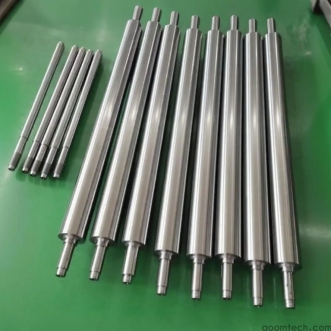
Turning is used for cylindrical components such as shafts, rollers, and pulley elements. In this process, the workpiece rotates while a cutting tool removes material.
Precision is essential to ensure concentricity and smooth surface finish. For elevator drive shafts, even slight imbalance can affect performance and cause vibration during operation.
Proper coolant usage and tool selection help reduce heat and extend tool life, especially when machining high-strength steel.
Drilling
Drilling is used to create accurate holes for assembly, fastening, and cable routing. Elevator components often require multiple precisely positioned holes to ensure correct installation.
For example, motor housings must have accurately drilled holes to align electrical and mechanical components correctly. Any deviation can lead to assembly issues or reduced system reliability.
Materials for CNC-Machined Elevator Components
Steel
Steel is the most commonly used material in elevator manufacturing due to its strength and durability. It is widely used in car frames, guide rails, and structural supports.
Different types include carbon steel and stainless steel. Stainless steel offers better corrosion resistance, while carbon steel provides excellent structural strength.
Machining steel requires robust tools and optimized cutting parameters due to its hardness. Cooling systems are also essential to maintain precision and tool life.
Aluminum
Aluminum is lightweight and corrosion-resistant, making it ideal for control panel housings and decorative components.
It is easier to machine than steel, but care must be taken to avoid tool deflection due to its softness. High-speed machining and proper tool geometry help achieve smooth surface finishes.
Materials for CNC-machined elevator components often include aluminum when weight reduction is a design priority.
Cast Iron
Cast iron is used in parts that require vibration damping and high load resistance, such as counterweights and base structures.
While it offers good stability, it is brittle and requires careful machining to avoid cracking or surface damage. Appropriate cutting speeds and tool selection are essential.
Challenges in Elevator Parts CNC Machining
Tool wear and breakage
Hard materials like steel can cause rapid tool wear. Small tools used for precision machining are also more prone to breakage.
Solutions include using carbide or coated tools, monitoring tool condition regularly, and optimizing toolpaths to reduce stress on cutting edges.
Heat generation
High-speed machining generates heat, which can affect dimensional accuracy and tool life. Excessive heat may also change material properties in critical components.
Effective cooling systems and optimized cutting parameters are essential to control temperature during machining.
Meeting stringent quality requirements
Elevator components must undergo strict inspection to ensure safety and performance. Even minor defects can lead to serious operational risks.
Manufacturers often use coordinate measuring machines (CMM), surface testers, and hardness testing to ensure compliance with industry standards. Quality control is not optional—it is a core requirement in elevator manufacturing.
Choosing a CNC Machining Service for Elevator Parts
Technical expertise
When selecting a supplier, technical knowledge is essential. The provider should understand elevator system requirements and have experience producing similar components.
Evaluating past projects, sample parts, and engineering capabilities helps determine whether the supplier can meet your specifications.
Choosing a provider for elevator parts CNC machining requires careful assessment of their experience in precision manufacturing and safety-critical industries.
Quality assurance system
A strong quality control system ensures consistent product reliability. Look for suppliers that use in-process inspections and final quality checks.
Key tools include:
Coordinate Measuring Machines (CMM)
Surface roughness testers
Hardness testing equipment
Proper documentation and traceability also help ensure compliance with international standards.
Cost and lead time
While cost is important, it should not compromise safety or quality. A reliable supplier should offer competitive pricing while maintaining strict production standards.
Short and predictable lead times are also important for large-scale elevator projects, where delays can impact entire construction schedules.
Conclusion
Elevator Parts CNC Machining is essential for producing safe, precise, and durable components used in modern elevator systems. From guide rails to structural frames, every part must meet strict performance and safety requirements.
Through advanced processes such as milling, turning, and drilling, CNC technology ensures high accuracy and consistency. When combined with proper material selection and strict quality control, it supports reliable elevator operation in demanding environments.
As the demand for safer and more efficient elevators continues to grow, CNC machining will remain a key technology in delivering high-performance elevator components worldwide.
RELATED PRODUCTS
-
Metal Parts CNC Machining
-
CNC Machining Services for Flashlight Ho
-
Metal Parts CNC Machining Services
-
Brass Parts CNC Machining Services
-
Roller CNC Machining Services
-
CNC machining of high-precision parts
-
CNC Machining for Sprockets
-
CNC Machining for Turbine Parts
-
CNC Machining Service for Crankshafts
-
CNC Machining Service for Copper Blocks