CNC Machining Connectors
CNC Machining Connectors: Precision Manufacturing for Reliable Connections
CNC Machining Connectors are essential components in modern engineering. They ensure secure electrical, mechanical, and fluid connections across a wide range of industries. From consumer electronics to aerospace systems, these small but critical parts enable stable signal transmission and reliable system performance.
Introduction to CNC Machining Connectors
Connectors are used to join circuits, pipes, or mechanical assemblies. Their job may seem simple, but their performance directly affects the safety and efficiency of entire systems. This is where CNC (Computer Numerical Control) machining becomes important.
CNC machining offers extremely high precision and repeatability, making it ideal for producing connectors with tight tolerances. Unlike manual manufacturing methods, CNC ensures each connector is identical, reliable, and suitable for mass production.
The importance of CNC-machined connectors lies in their ability to support complex technologies where even a minor defect can lead to system failure. This makes them a core part of modern manufacturing.
The CNC Machining Process for Connectors
Design and Programming
The CNC machining process for connectors begins with design. Engineers use CAD (Computer-Aided Design) software to create a detailed 3D model of the connector. This model defines shape, size, tolerances, and functional features such as pins, holes, and slots.
Next, CAM (Computer-Aided Manufacturing) software converts the design into machine-readable instructions. Programmers define toolpaths, spindle speeds, feed rates, and cutting depths. Even a small programming error can lead to poor fit or functional failure, especially in high-precision connector applications.
Machine Setup and Tooling
Before machining begins, the CNC machine is carefully set up. Fixtures are used to hold the workpiece securely in place, preventing vibration or movement during cutting. Since connectors require high accuracy, stable clamping is critical.
Tool selection depends on material and geometry. Common tools include carbide end mills, drills, and reamers. Each tool is selected based on whether the operation involves milling, drilling, or finishing. Machine settings such as spindle speed and feed rate are adjusted according to material properties and design requirements.
Machining Operations
Milling is used to form flat surfaces, grooves, and complex shapes. Different end mills are used depending on the geometry—ball-nose tools for curved surfaces and square-end tools for sharp edges. Proper chip evacuation is necessary to maintain surface quality and prevent tool damage.
Drilling creates precise holes for pins, screws, or fluid channels. Accuracy in hole diameter and position is critical. Incorrect drilling can cause misalignment and connection failure, making tool selection and cutting parameters extremely important.
Materials Used for CNC Machined Connectors
Metals
Materials for CNC-machined connectors often include brass, copper, and aluminum.
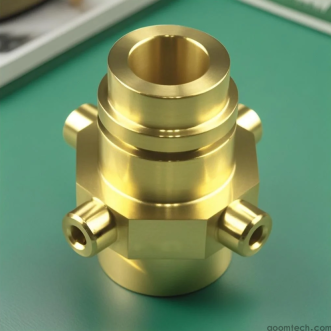
Brass: Offers excellent machinability, corrosion resistance, and electrical conductivity.
Copper: Provides superior electrical performance, commonly used in high-conductivity applications.
Aluminum: Lightweight and widely used in aerospace and portable devices.
Each metal affects machining parameters such as cutting speed, tool wear, and cooling requirements.
Plastics
Plastics are also widely used in connector manufacturing.
Nylon: Strong, durable, and electrically insulating.
PEEK: High-temperature resistance for extreme environments.
ABS: Cost-effective and easy to machine.
Plastic machining requires careful control of heat generation to prevent deformation or melting.
Challenges in CNC Machining Connectors
Precision Requirements
Connectors require extremely tight tolerances. Even a small deviation can lead to poor electrical contact or mechanical failure. To maintain accuracy, manufacturers rely on calibrated machines and high-precision measuring tools.
Complex Geometries
Modern connectors often include intricate shapes, multiple holes, and fine details. Producing these features requires advanced CNC programming and sometimes multi-axis machining systems to ensure accuracy and efficiency.
Material-Specific Challenges
Different materials behave differently during machining. Metals like brass may harden during cutting, increasing tool wear. Plastics may deform due to heat. Proper coolant usage and optimized cutting parameters are essential to overcome these challenges.
Quality Control in CNC Machining of Connectors
In-Process Inspection
Quality control in CNC machining of connectors begins during production. Operators continuously check dimensions, surface finish, and tool condition using calipers, micrometers, and surface testers.
If deviations are detected, machine parameters are adjusted immediately to prevent defects from continuing.
Final Inspection
After machining, each connector undergoes detailed inspection. This includes dimensional verification, surface quality checks, and functional testing such as electrical conductivity or pressure sealing.
Non-conforming parts are either reworked or discarded depending on the severity of the defect. This ensures only high-quality connectors reach the final application.
Applications of CNC Machined Connectors
Electronics Industry
CNC machined connectors are widely used in PCBs, smartphones, computers, and communication systems. Their precision ensures stable electrical signals and supports device miniaturization and high-performance computing.
Automotive Industry
In vehicles, connectors are used in wiring systems, sensors, fuel systems, and control units. High durability and accuracy are essential for safety and performance, especially in electric and autonomous vehicles.
Aerospace Industry
Aerospace systems require connectors that can withstand vibration, temperature changes, and pressure variations. CNC machining ensures these connectors meet strict safety and reliability standards.
Conclusion: Mastering CNC Machining for Connectors
Producing high-quality CNC Machining Connectors requires precision engineering, material knowledge, and strict quality control. From design and programming to final inspection, every step plays a critical role in performance and reliability.
Key takeaways include the importance of accurate CAD/CAM design, proper tool selection, and careful material handling. Understanding these factors helps manufacturers achieve consistent quality and reduce production errors.
As industries continue to demand smaller, faster, and more reliable systems, the role of CNC-machined connectors will only become more important. Staying updated with modern machining techniques and investing in advanced inspection tools are essential for long-term success.
RELATED PRODUCTS
-
Metal Parts CNC Machining
-
CNC Machining Services for Flashlight Ho
-
Metal Parts CNC Machining Services
-
Brass Parts CNC Machining Services
-
Roller CNC Machining Services
-
CNC machining of high-precision parts
-
CNC Machining for Sprockets
-
CNC Machining for Turbine Parts
-
CNC Machining Service for Crankshafts
-
CNC Machining Service for Copper Blocks