


CNC Machining Process for Plastic Steel Parts
Introduction to CNC Machining of Plastic Steel Parts
The CNC Machining Process for Plastic Steel Parts is widely used in modern manufacturing to produce high-precision components with strong mechanical performance and good durability. Plastic steel is a type of engineering material that combines plastic-based polymers with enhanced strength characteristics similar to steel reinforcement. This combination provides benefits such as lightweight structure, corrosion resistance, and improved mechanical strength.
Overview of Plastic Steel and Its Applications
Plastic steel is commonly used in industries where parts must be strong but not too heavy. It offers a balance between rigidity and flexibility, making it suitable for different engineering environments.
Construction: Window frames, door profiles, sealing systems
Automotive: Interior panels, brackets, lightweight housings
Electronics: Protective enclosures, connectors, insulating components
These applications show why plastic steel has become an important material in precision manufacturing, especially for custom-designed parts.
Pre-Machining Considerations for Plastic Steel Parts
Before starting machining, engineers must carefully evaluate material behavior and design requirements. These pre-machining considerations for CNC plastic steel part processing directly affect quality, cost, and production efficiency.
Part Design Optimization
Design optimization is essential to ensure smooth CNC machining and prevent deformation during processing. Plastic steel has a lower melting point and different thermal behavior compared to metals, so heat generation must be controlled.
Key design guidelines include:
Avoid sharp internal corners to reduce stress concentration
Use fillets instead of sharp edges for improved strength distribution
Maintain uniform wall thickness to prevent warping
Apply proper draft angles for easier part release in post-processing
Using CAD/CAM simulation tools helps detect design flaws before production begins and ensures the machining process runs efficiently.
Plastic Steel Grade Selection
Selecting the right plastic steel grade is critical for achieving the required performance. Different grades offer different levels of strength, heat resistance, and impact resistance.
For example:
High-impact grades are suitable for structural components
Heat-resistant grades are used in high-temperature environments
Flexible grades are ideal for vibration-resistant parts
The chosen grade directly influences tool selection, cutting speed, and final product durability in CNC machining operations.
CNC Machining Operations for Plastic Steel Parts
Milling Operations in CNC Plastic Steel Part Machining
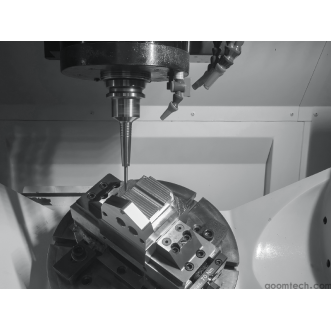
Milling is one of the most common operations in plastic steel machining. It is used to create flat surfaces, slots, cavities, and complex 3D shapes.
Due to the material’s thermal sensitivity, careful control of cutting conditions is required. Carbide-tipped end mills are commonly used for stability and wear resistance.
Recommended machining parameters include:
High spindle speed to ensure smooth cutting
Moderate to low feed rate to avoid overheating
Shallow depth of cut for dimensional accuracy
Proper toolpath programming in CAD/CAM software ensures efficient cutting and reduces material deformation risks.
Turning Operations (If Applicable)
When plastic steel parts are cylindrical, CNC turning is used. The workpiece rotates while a cutting tool shapes the surface.
Typical turning operations include:
Facing for flat surface creation
Turning for diameter reduction
Grooving and threading for functional features
Careful control of spindle speed and feed rate is important to avoid melting or surface defects. Proper coolant application may also be used to improve chip removal and surface finish quality.
Drilling and Boring Operations
Holes in plastic steel parts require controlled drilling and finishing processes. Drilling creates the initial hole, while boring improves accuracy and surface quality.
To prevent issues such as burr formation or hole deformation:
Use sharp drill bits designed for polymer-based materials
Apply peck drilling to break chips effectively
Maintain correct tool alignment for precision hole placement
Tooling and Fixturing for Plastic Steel Parts
Tool Selection
Tool selection plays a key role in machining quality. Carbide tools are widely used due to their hardness and wear resistance.
Important tool geometry factors include:
Positive rake angle to reduce cutting force
Proper clearance angle to avoid friction
Optimized helix angle for efficient chip removal
Regular tool inspection is necessary to maintain consistent machining accuracy and surface quality.
Fixturing Design
A stable fixturing system is essential for accurate machining. Plastic steel is softer than metals, so over-clamping must be avoided.
Common fixturing solutions include:
Vacuum chucks for thin-walled parts
Soft jaws to prevent surface damage
Custom fixtures with multiple support points
Proper fixture alignment ensures dimensional accuracy throughout the CNC machining process for plastic steel parts.
Quality Control in CNC Machining of Plastic Steel Parts
In-Process Inspection
Continuous inspection during machining is essential for maintaining quality. This is a key part of quality control in CNC-machined plastic steel parts.
Common inspection points include:
Slot width and depth accuracy
Flatness of machined surfaces
Diameter and roundness of drilled holes
Tools such as calipers, micrometers, and surface roughness testers are commonly used for measurement.
Final Inspection and Testing
After machining, each part undergoes final inspection to ensure it meets design specifications. This includes dimensional checks, surface evaluation, and sometimes functional testing.
If a part fails inspection, it may be reworked, adjusted in the machining process, or rejected depending on severity.
Post-Machining Processes for Plastic Steel Parts
Deburring and Edge Finishing
Machined plastic steel parts often contain sharp edges or burrs. These must be removed to improve safety and functionality.
Common methods include:
Manual deburring tools
Abrasive finishing systems
Chamfering and edge rounding operations
Edge finishing also helps reduce stress concentration and improves product durability.
Surface Treatment
Surface treatment enhances both appearance and performance. Depending on application requirements, different coatings or finishes may be applied.
Common treatments include:
Protective painting for aesthetics and durability
UV-resistant coatings for outdoor applications
Anti-corrosion surface layers for harsh environments
Choosing the right treatment depends on the part’s working environment and expected service life.
Conclusion
The CNC Machining Process for Plastic Steel Parts requires careful attention to design, material selection, machining parameters, tooling, and quality control. By following proper engineering practices and using modern CNC technology, manufacturers can produce high-quality, durable, and cost-effective components.
Understanding every stage—from design optimization to final surface treatment—helps ensure stable production and reliable part performance in real-world applications.
 Process of Custom High-Precisi
 CNC Machining Parameter Settin
 5 Key Tips for CNC Machining o
 Small-batch Precision Parts 5-