

Factors Affecting CNC Machining Pricing
Introduction to CNC Machining Pricing Factors
The Significance of Understanding Pricing Factors
Understanding Factors Affecting CNC Machining Pricing is important for both buyers and manufacturers. For buyers, it helps create accurate budgets, avoid unexpected costs, and choose the best value solution. For manufacturers, it supports fair pricing that remains competitive while still ensuring profitability.
Without this understanding, problems can easily happen. For example, a buyer may receive a quotation that is much higher than expected because they did not consider material or tolerance requirements. On the other hand, a seller who ignores real production costs may set prices too low and lose money or fail to sustain production.
Material-Related Factors
Material Type and Grade
One of the most important material-related factors in CNC machining pricing is the type of material used. Different materials have very different raw costs and machining behaviors.
Common materials include aluminum, carbon steel, stainless steel, titanium, and engineering plastics. Aluminum is usually cost-effective and easy to machine. Stainless steel is stronger and more corrosion-resistant but requires more machining time. Titanium is significantly more expensive due to its complex extraction process and difficult cutting properties.
Even within the same material type, different grades can change the price. For example, high-strength stainless steel grades or aerospace-grade aluminum cost more because they offer better mechanical performance and stricter material control.
In many CNC projects, material cost can account for 20% to 60% of the total machining price depending on part size and material choice.
Material Availability and Procurement Costs
Material availability also strongly influences pricing. If a material is rare, special-order, or not locally available, the cost will increase.
For example, importing a specific stainless steel grade from overseas can add shipping fees, customs duties, and longer lead times. Storage and supplier handling costs may also increase the final price.
To reduce cost, buyers can consider using local suppliers, choosing standard material grades, or planning long-term contracts with stable pricing. These strategies help reduce risk from market price changes and supply chain delays.
Part-Related Factors
Part Complexity
Part-complexity impact on CNC machining cost is one of the strongest pricing drivers. The more complex a part is, the more time, tools, and machine operations are required.
Complex parts may include deep cavities, thin walls, tight corners, multi-axis surfaces, or many small features such as holes and threads. A simple flat bracket is fast to machine, while a 3D curved aerospace component may require many hours of programming and machining.
Manufacturers often evaluate complexity by counting features, number of setups, and the need for multi-axis machining. Higher complexity always increases machining time and labor cost.
Tolerance Requirements
Tolerance defines how precise a part must be. Tighter tolerances increase cost because they require slower cutting speeds, more stable machines, and additional inspection steps.
For example, a general tolerance of ±0.1mm is relatively easy to achieve. However, a tight tolerance of ±0.01mm requires precision equipment and careful quality control, which increases production time and cost.
Tight tolerances are essential in industries like aerospace, medical devices, and automotive safety systems. However, applying tight tolerances where they are not needed can significantly increase unnecessary costs.
Surface Finish Requirements
Surface finish also affects CNC pricing. A basic machined surface is cheaper, while high-quality finishes require extra steps such as polishing, grinding, or fine machining.
For instance, a functional mechanical part may only need a standard finish, while a decorative or sealing surface may require a smooth, mirror-like finish with low roughness values.
Each additional finishing process increases labor time, tool wear, and overall cost.
Machining-Process Factors
Machining Operations
Different machining operations have different cost structures. Milling, turning, drilling, tapping, and grinding all require different tools and time.
Milling complex shapes usually takes longer than drilling simple holes. Turning long cylindrical parts is efficient, but may still require special setups depending on geometry.
The more operations required, the higher the total machining cost due to increased machine time and setup complexity.
Machine Type and Capabilities
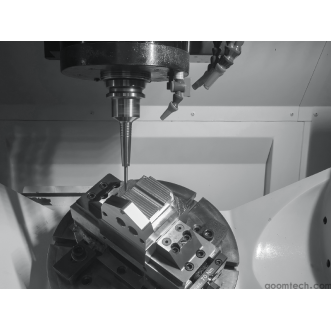
The type of CNC machine used directly affects pricing. A 3-axis CNC machine is generally more affordable to operate, while a 5-axis machine is more expensive but can produce highly complex parts in fewer setups.
5-axis machining is often used for aerospace components or complex curved surfaces. Although it increases hourly machine cost, it can reduce total production time for complex parts.
Machine capabilities such as spindle speed, accuracy, and maximum workpiece size also influence cost depending on part requirements.
Tooling and Fixturing
Tooling and fixturing are often hidden but important cost factors. Cutting tools wear out over time, especially when machining hard materials like stainless steel or titanium.
Special tools such as small-diameter cutters or diamond-coated tools are more expensive and may increase cost per part.
Fixturing holds the part in place during machining. Simple parts may use standard fixtures, but complex parts often require custom-designed fixtures, which add setup cost.
Quantity-Related Factors
Economies of Scale
Quantity-based pricing in CNC machining plays a major role in cost reduction. When production quantity increases, the cost per part usually decreases.
This happens because fixed costs such as programming, setup, and tooling are shared across more units. For example, a $500 setup cost equals $50 per part for 10 parts, but only $5 per part for 100 parts.
This is why large production batches are significantly more cost-efficient than small orders.
Minimum Order Quantity (MOQ)
Some manufacturers set a minimum order quantity (MOQ) to cover setup and operational costs. Small orders below this threshold may have higher per-unit pricing.
MOQs exist because machine setup and programming costs remain the same whether producing 1 part or 100 parts. To manage this, buyers can combine orders, increase batch size, or negotiate long-term partnerships.
Other Important Factors
Geographical Location
Location affects labor cost, overhead, and shipping expenses. CNC machining services in regions with high labor costs are usually more expensive.
Additionally, international shipping, import taxes, and logistics costs can significantly increase the final delivered price. Choosing a supplier closer to your supply chain can reduce total cost and lead time.
Lead Time
Lead time is another key pricing factor. Shorter delivery times often cost more because manufacturers may need to prioritize urgent jobs, adjust production schedules, or work overtime.
If a project allows flexible scheduling, longer lead times can help reduce cost. Planning ahead is one of the most effective ways to control CNC machining expenses.
Conclusion
In summary, Factors Affecting CNC Machining Pricing include material selection, part complexity, tolerance requirements, machining processes, quantity, location, and lead time. Each factor plays an important role in determining the final cost.
By understanding these elements, buyers can make smarter decisions, optimize design choices, and reduce unnecessary expenses. At the same time, manufacturers can provide more accurate and transparent quotations.
A clear understanding of pricing factors leads to better communication, fewer misunderstandings, and more successful CNC machining projects.
 Process of Custom High-Precisi
 CNC Machining Parameter Settin
 5 Key Tips for CNC Machining o
 Small-batch Precision Parts 5-