


Guide to 5-Axis CNC Machining of Complex Parts
The Guide to 5 - Axis CNC Machining of Complex Parts explains how modern manufacturing creates highly complex components with high accuracy and efficiency. This machining method is widely used in aerospace, automotive, and medical industries where precision and complex geometry are required.
Introduction to 5 - Axis CNC Machining
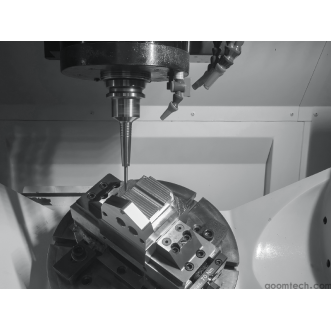
5 - axis CNC machining is a manufacturing process where a cutting tool moves along five different axes at the same time. These include three linear axes (X, Y, Z) and two rotational axes (A and B or C). This allows the tool to approach the workpiece from almost any direction.
In traditional 3 - axis machining, the tool only moves in X, Y, and Z directions. The workpiece often needs to be repositioned multiple times to reach different surfaces. This increases setup time and may introduce alignment errors.
With 5 - axis machining, complex shapes like turbine blades can be produced in a single setup. This reduces handling and improves accuracy compared to multiple setups in 3 - axis machining.
Benefits of 5 - Axis CNC Machining for Complex Parts
The benefits of 5 - axis machining for complex parts are significant and make it a preferred choice in advanced manufacturing.
Higher precision: The part does not need to be repositioned frequently, reducing cumulative errors.
Better surface finish: The tool can maintain an optimal cutting angle, producing smoother surfaces.
Reduced production time: Fewer setups mean faster overall machining.
Improved tool access: The tool can reach difficult areas without special fixtures.
For example, in aerospace manufacturing, turbine blades require high aerodynamic precision. 5 - axis machining allows these blades to be finished in fewer steps with consistent quality. In the medical field, surgical instruments benefit from smoother surfaces and tight tolerances achieved through this process.
Types of Complex Parts Suited for 5 - Axis Machining
5 - axis machining is ideal for parts with complex geometries that cannot be easily produced using traditional methods.
Aerospace components: Impellers, turbine blades, and structural brackets with curved surfaces.
Automotive parts: High-performance engine blocks, transmission housings, and custom performance parts.
Medical components: Dental implants, orthopedic tools, and surgical instruments.
These parts often require machining from multiple angles. Without 5 - axis capability, multiple setups would be needed, increasing time and risk of error.
Pre - machining Considerations
Design and CAD/CAM
A well-prepared 3D model is essential for successful machining. CAD/CAM software is used to design the part and generate tool paths.
When working with programming for 5 - axis machining of complex parts, engineers must carefully consider tool access, collision risks, and part orientation. Simulation tools are important to detect errors before machining begins.
Design tips include:
Reduce unnecessary complex features where possible
Ensure smooth transitions in curved surfaces
Plan tool access for all critical areas
Material Selection
Different materials behave differently during machining. Hard metals like titanium require slower cutting speeds and stronger tools, while softer materials like plastics allow faster machining but may deform easily.
Key material factors include:
Hardness
Ductility
Heat resistance
These factors directly affect tool selection and machining strategy.
Machining Process
Machine Setup
Proper setup is critical for accurate 5 - axis machining. The machine must be calibrated to ensure all rotational and linear axes are precise.
A basic setup checklist includes:
Machine calibration and axis alignment
Secure and stable workholding system
Verification of tool length and offsets
Dry run simulation before cutting
Tooling in 5 - Axis CNC Machining of Complex Parts
The tooling in 5 - axis CNC machining of complex parts plays a key role in achieving precision and efficiency.
Common tooling considerations include:
High-rigidity end mills for reduced vibration
Long-reach tools for deep cavities
Coated tools (TiAlN, TiN) for improved wear resistance
Tool geometry must match the part features. For example, ball-nose tools are often used for smooth curved surfaces, while flat end mills are used for flat areas and sharp edges.
Cutting Parameters
Cutting parameters must be carefully adjusted based on material and tool type.
Spindle speed: Higher for aluminum, lower for titanium and stainless steel
Feed rate: Reduced for hard materials to avoid tool breakage
Depth of cut: Shallower cuts for complex geometries to improve stability
Balancing these parameters ensures tool life and surface quality.
Programming
Modern 5 - axis machining relies heavily on CAD/CAM programming. Tool paths are generated digitally and optimized for smooth movement across all axes.
Simulation is essential before actual machining. It helps detect:
Tool collisions
Machine axis limits
Incorrect tool orientations
This step reduces costly errors and improves production safety.
Post - machining Operations
After machining, several finishing steps may be required to improve part quality.
Deburring: Removes sharp edges for safety and functionality
Surface finishing: Includes polishing, sandblasting, or coating to improve appearance and performance
Heat treatment: Enhances hardness, strength, and wear resistance for high-stress applications
Quality Control
Quality control is essential in 5 - axis machining to ensure dimensional accuracy and product reliability.
Common inspection methods include:
Coordinate Measuring Machines (CMM): For precise dimensional verification
Non-destructive testing (NDT): Such as ultrasonic or X-ray inspection for internal defects
In-process inspection: Checking critical dimensions during machining to prevent errors early
Strict quality control ensures that complex parts meet industry standards in aerospace, automotive, and medical applications.
Conclusion
The Guide to 5 - Axis CNC Machining of Complex Parts highlights how this advanced technology improves precision, reduces production time, and enables the manufacturing of highly complex components. By understanding proper design, tooling, machining parameters, and quality control, manufacturers can fully benefit from 5 - axis machining in demanding industrial applications.
 Process of Custom High-Precisi
 CNC Machining Parameter Settin
 5 Key Tips for CNC Machining o
 Small-batch Precision Parts 5-