CNC Machining for Impeller Manufacturing
CNC Machining for Impeller Manufacturing is a key process in modern engineering industries. It helps produce highly precise and complex impeller parts used in pumps, compressors, turbines, and many other machines. Because impellers directly affect fluid movement and energy transfer, their accuracy is extremely important for performance, safety, and efficiency.
This article explains the CNC machining process for impeller manufacturing, its importance, main steps, challenges in CNC impeller machining, and the benefits of CNC in impeller manufacturing. The goal is to help readers understand the topic in simple and practical terms.
Introduction to CNC Machining in Impeller Manufacturing
The Importance of Impellers and CNC Machining
Impellers are rotating components that move fluids such as air, water, or gas. They are widely used in aerospace systems, automotive engines, energy plants, and industrial equipment. For example, in a jet engine, a precisely manufactured impeller helps compress air efficiently, which is essential for thrust and power generation.
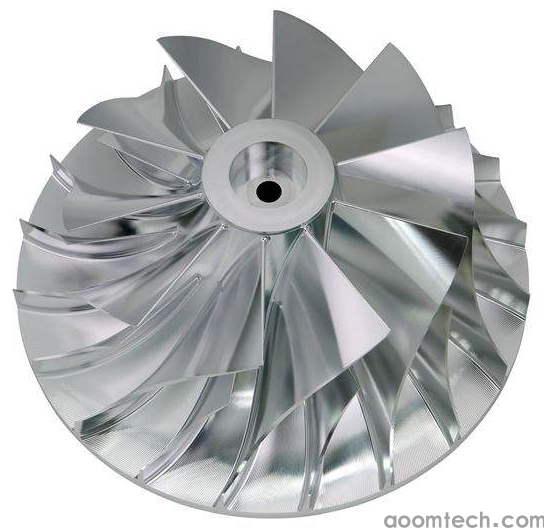
Because impellers often have complex curved blades, traditional manufacturing methods are not enough. CNC (Computer Numerical Control) machining allows manufacturers to produce accurate and repeatable shapes with tight tolerances. This makes it one of the most reliable methods for modern impeller production.
The CNC Machining Process for Impeller Manufacturing
Design and Engineering
The process begins with design and engineering. Engineers use CAD (Computer-Aided Design) software to build a detailed 3D model of the impeller. This model defines blade shape, angles, diameter, and flow path.
Good design is critical. Even small mistakes, such as incorrect blade angles, can reduce efficiency and cause fluid flow problems. Engineers carefully simulate fluid movement to ensure the impeller performs correctly under real operating conditions.
Material Selection
Choosing the right material is an important step in impeller manufacturing. Common materials include stainless steel, aluminum, and titanium.
Stainless steel: Used for corrosion resistance in chemical and marine environments.
Aluminum: Lightweight and suitable for applications requiring lower weight.
Titanium: Strong, heat-resistant, and used in aerospace applications.
Each material affects machining speed, tool wear, and cost. For example, stainless steel requires slower cutting speeds and stronger tools compared to aluminum.
CNC Programming
The CAD model is converted into machine instructions using CAM (Computer-Aided Manufacturing) software. This creates a CNC program that includes toolpaths, spindle speed, feed rate, and cutting depth.
Precision in programming is essential. Poor toolpath planning can lead to uneven surfaces or incorrect blade geometry. A well-optimized program ensures smooth machining and accurate final dimensions.
Machine Setup and Tooling
Before machining begins, the CNC machine is prepared with suitable tools and fixtures. Special end mills and multi-axis setups are often required for impeller shapes.
Correct setup ensures stability and accuracy. Wrong tool selection or poor clamping can lead to vibration, tool breakage, or part deformation, which may ruin the impeller.
Machining Operations
Milling
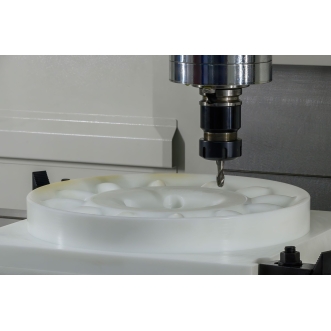
Milling is the primary operation in impeller production. A rotating cutting tool removes material layer by layer to form blades and hubs.
For hard materials like stainless steel, carbide tools are commonly used. Cutting parameters must be carefully controlled. For delicate blade areas, slower feed rates are used to maintain accuracy and surface quality.
Turning (if applicable)
Turning is used when cylindrical features such as hubs are required. The workpiece rotates while a cutting tool shapes the outer surface.
Maintaining concentricity is important to ensure smooth rotation in the final application. Proper cutting conditions also help reduce vibration and improve surface finish.
Quality Control
Quality control is essential in CNC machining for impeller manufacturing. Since impellers are used in high-performance systems, even small defects can cause major issues.
Inspection methods include:
In-process measurement for dimensional accuracy
Surface roughness checks using profilometers
Final inspection using CMM (Coordinate Measuring Machines)
If a part does not meet specifications, it may be reworked or rejected to ensure system reliability.
Challenges in CNC Machining for Impeller Manufacturing
Complex Geometry
Impellers have complex curved blades that are difficult to machine. Multi-axis CNC machines are often required to achieve the correct shape. Advanced simulation software is used to avoid collisions and optimize toolpaths before actual production.
Material-Related Challenges
Some materials used in impellers, such as titanium or high-strength alloys, are difficult to machine. They generate heat and cause faster tool wear. Manufacturers often use advanced coatings, cooling systems, and specialized cutting tools to solve these problems.
High-Precision Requirements
Impellers require very tight tolerances. Even small deviations can reduce efficiency and increase energy loss. To meet these standards, manufacturers rely on high-precision machines and strict inspection systems.
Benefits of CNC Machining for Impeller Manufacturing
High Precision and Accuracy
One of the biggest benefits of CNC machining is accuracy. Computer-controlled systems ensure consistent production with minimal error. This leads to better performance in pumps, compressors, and turbines.
Customization Capability
CNC machining allows full customization of impeller designs. Engineers can create unique shapes for specific applications, such as energy-saving pumps or high-speed turbines. This flexibility supports innovation across industries.
Efficiency and Productivity
Once a CNC program is created, the machining process can run automatically. Machines can operate continuously with minimal human intervention, improving production speed and reducing labor costs.
This is especially useful for mass production, where consistency and speed are important.
Conclusion: The Role of CNC Machining in Impeller Manufacturing
CNC Machining for Impeller Manufacturing plays a critical role in modern engineering. It enables the production of highly accurate, efficient, and customized impellers used in many industries.
Understanding the CNC machining process for impeller manufacturing, along with its challenges in CNC impeller machining and benefits of CNC in impeller manufacturing, helps engineers and manufacturers improve product quality and efficiency.
To achieve the best results, manufacturers should focus on continuous process improvement, proper material selection, skilled operator training, and the use of advanced CNC technologies. These efforts ensure reliable and high-performance impeller production in demanding industrial applications.
RELATED PRODUCTS
-
Medical Brass CNC Machining Parts
-
Precision CNC Machining PEEK Services
-
Precision Custom CNC Machined Car Parts
-
cnc machining optical housings
-
Precision CNC Casting Machining Services
-
Precision Gear CNC Machining Services
-
Precision Stainless Steel Parts CNC Mach
-
CNC Machining of Precision Aluminum Tube
-
CNC Machining of Large Precision Aluminu
-
CNC Machining & Manufacturing of Pre