CNC Machining Service for Crankshafts
Introduction to CNC Machining Service for Crankshafts
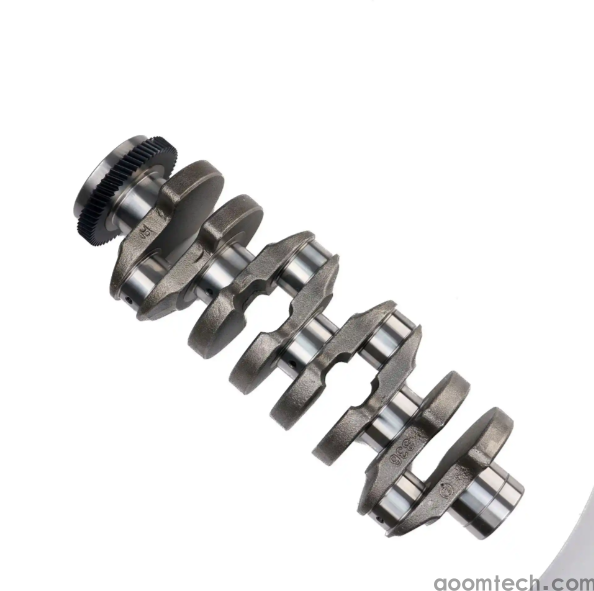
A CNC Machining Service for Crankshafts is a specialized manufacturing process used to produce one of the most important rotating parts in an engine. A crankshaft is a core component in an internal combustion engine, responsible for converting the up-and-down (reciprocating) motion of pistons into smooth rotational motion that powers vehicles and machines.
Crankshafts are used in many applications, including automotive engines, marine engines, motorcycles, generators, and heavy industrial machinery. For example, in a car engine, the crankshaft transfers power from the pistons to the transmission, allowing the wheels to move efficiently.
Because crankshafts operate under high stress, heat, and continuous rotation, they must be manufactured with extreme precision and strength. This is where CNC machining becomes essential.
The Significance of Crankshafts
Crankshafts are critical for engine performance, durability, and efficiency. They are designed with multiple crankpins, journals, and counterweights that must work in perfect balance.
In different engines, crankshafts vary in size and design:
Automotive engines: Designed for balance, fuel efficiency, and long service life
Marine engines: Built for high torque and corrosion resistance
Industrial engines: Focused on durability under continuous operation
Without a properly manufactured crankshaft, engines may suffer from vibration, power loss, or even complete mechanical failure.
Importance of CNC Machining for Crankshafts
Precision Manufacturing
CNC machining enables extremely high precision in crankshaft production. Every dimension—such as journal diameter, crankpin offset, and fillet radius—must meet tight tolerances.
This precision ensures:
Smooth engine operation
Reduced vibration and noise
Lower wear and longer service life
Improved fuel efficiency
If a crankshaft is not precise, it can lead to engine knocking, reduced power output, and increased fuel consumption.
Complex Geometries and Customization
CNC technology allows manufacturers to produce crankshafts with complex and customized designs. Different engines require different crankshaft geometries depending on performance goals.
Examples include:
High-performance crankshafts with optimized counterweights for better balance
Special journal shapes to improve lubrication flow
Custom designs for racing or heavy-duty industrial engines
This flexibility makes CNC machining ideal for both mass production and custom engineering projects.
Cost-Effectiveness for Batch Production
Once the CNC program is created, crankshafts can be produced repeatedly with consistent quality. This makes CNC machining highly cost-effective for batch production.
Benefits include:
Reduced setup time
Efficient material usage
Lower per-unit cost in large production runs
For example, automotive manufacturers producing thousands of identical crankshafts benefit significantly from CNC automation and repeatability.
CNC Machining Processes for Crankshafts
Turning (CNC Turning for Crankshafts)
CNC turning for crankshafts is one of the most important machining steps. In this process, the workpiece rotates while a cutting tool removes material to form cylindrical surfaces such as journals and crankpins.
Key considerations include:
Tool selection based on material type (steel or cast iron)
Cutting speed, feed rate, and depth of cut optimization
Maintaining concentricity between rotating surfaces
Sharp and high-quality tools are essential to achieve accurate dimensions and smooth surface finishes.
Milling
Milling is used to create non-cylindrical features such as keyways, flat surfaces, and slots on the crankshaft. Different milling cutters are used depending on the feature design.
Accurate alignment between milled and cylindrical surfaces is critical to ensure proper assembly and engine function.
Grinding
Grinding is typically the final step in crankshaft machining. It ensures high surface quality and precise dimensional accuracy.
This process improves:
Surface smoothness
Roundness and cylindricity
Fatigue resistance
A smooth surface reduces friction, which is especially important in high-performance engines.
Materials Used in CNC Machining of Crankshafts
Alloy Steel
Materials for CNC-machined crankshafts often include alloy steel due to its excellent strength, fatigue resistance, and toughness. Elements like chromium, nickel, and molybdenum improve mechanical properties.
However, alloy steel is harder to machine and requires strong cutting tools and optimized machining conditions. Despite this challenge, it is widely used in automotive and high-performance engines.
Cast Iron
Cast iron is another common material used for crankshafts, especially in cost-sensitive applications. It offers good vibration damping properties, which help reduce engine noise.
Its machining is easier than alloy steel, but care must be taken due to its brittleness. Proper cutting speeds and tool selection are important to avoid chipping.
Challenges in CNC Machining of Crankshafts
Work Hardening
During machining, some materials become harder at the surface due to deformation. This increases tool wear and makes further cutting more difficult.
Solutions include:
Using sharp cutting tools
Applying proper coolant
Optimizing cutting parameters
Tool Wear
Crankshaft machining involves hard materials and long production cycles, which can cause rapid tool wear.
To manage this issue, manufacturers often use carbide or coated tools and monitor tool condition regularly. Predictive maintenance helps avoid unexpected downtime.
Maintaining Dimensional Accuracy
Crankshafts have complex shapes and multiple machining steps, making it difficult to maintain perfect accuracy.
Solutions include:
In-process measurement using CMM (Coordinate Measuring Machine)
Tool compensation systems
Frequent quality inspections
Choosing a CNC Machining Service Provider for Crankshafts
Technical Expertise
When selecting a provider for choosing a provider for CNC crankshaft machining, technical experience is one of the most important factors. A good provider should understand crankshaft design, materials, and precision requirements.
Reviewing past projects, certifications, and sample parts can help evaluate their capability.
Quality Assurance System
A reliable CNC machining provider must have a strong quality control system. This includes both in-process and final inspections using precision instruments such as micrometers, surface testers, and CMM machines.
A structured quality system ensures that every crankshaft meets strict performance and durability standards.
Cost-Effectiveness and Lead Time
While cost is important, it should not compromise quality. A good provider offers a balance between pricing, precision, and delivery time.
Comparing multiple suppliers and reviewing their delivery history helps ensure reliable production scheduling.
Conclusion
A CNC Machining Service for Crankshafts plays a vital role in modern engine manufacturing. Through precise machining processes like turning, milling, and grinding, manufacturers can produce durable and high-performance crankshafts for a wide range of applications.
By understanding CNC turning for crankshafts, materials for CNC-machined crankshafts, and choosing a provider for CNC crankshaft machining, businesses can make informed decisions and achieve better engine performance, reliability, and cost efficiency.
RELATED PRODUCTS
-
Medical Brass CNC Machining Parts
-
Precision CNC Machining PEEK Services
-
Precision Custom CNC Machined Car Parts
-
cnc machining optical housings
-
Precision CNC Casting Machining Services
-
Precision Gear CNC Machining Services
-
Precision Stainless Steel Parts CNC Mach
-
CNC Machining of Precision Aluminum Tube
-
CNC Machining of Large Precision Aluminu
-
CNC Machining & Manufacturing of Pre