CNC Machining for Medical Precision Parts
CNC Machining for Medical Precision Parts plays a critical role in modern healthcare manufacturing. From surgical instruments to orthopedic implants, CNC (Computer Numerical Control) machining enables the production of highly accurate, safe, and reliable components used in life-saving medical devices.
This article explains how CNC machining is used in the medical industry, why precision is so important, the materials involved, the machining process, and how quality is controlled to meet strict medical standards.
Introduction to CNC Machining for Medical Precision Parts
The Significance of Medical Precision Parts
Medical precision parts are the foundation of modern medical devices and equipment. These components ensure the accuracy, reliability, and safety of medical procedures such as surgery, diagnosis, and rehabilitation.
Without high-quality precision parts, many advanced medical technologies would not function properly. Devices like implants, surgical tools, infusion pumps, and imaging systems all depend on tightly controlled manufacturing processes.
CNC machining has become essential because it can produce complex shapes with extremely tight tolerances, repeatability, and consistency—key requirements in the medical field.
Unique Requirements of CNC Machining for Medical Precision Parts
Extreme Precision and Tight Tolerances
Medical components often require tolerances in the micrometer range. Even the smallest dimensional error can lead to serious consequences, such as poor implant fit or device malfunction.
For example, in orthopedic implants or dental components, incorrect sizing can cause discomfort, improper healing, or failure of the implant.
CNC machines use computer-controlled toolpaths that allow extremely accurate movement. This makes it possible to consistently produce parts with very high precision and repeatability.
Biocompatibility
Biocompatibility is essential for any part that will come into contact with the human body. Materials must not cause allergic reactions, toxicity, or rejection by the body.
In CNC machining, maintaining biocompatibility depends on two key factors:
Using certified medical-grade materials
Avoiding contamination during machining and handling
Manufacturers must ensure cutting fluids, machine residues, and environmental contamination do not affect the final product.
Surface Finish and Cleanliness
A smooth surface finish reduces the risk of infection and improves the performance of medical parts. Rough surfaces can trap bacteria and lead to complications.
CNC machining can achieve fine surface finishes through optimized cutting tools and parameters. After machining, parts must go through cleaning and decontamination processes to remove oils, chips, and microscopic debris.
The CNC Machining Process for Medical Precision Parts
Design and Programming
The process begins with CAD (Computer-Aided Design), where engineers create a detailed 3D model of the medical part. This design considers mechanical function, stress conditions, and strict medical standards.
Next, CAM (Computer-Aided Manufacturing) software converts the design into CNC machine instructions. Skilled programmers define toolpaths, cutting speeds, feed rates, and depth of cut.
Even a small programming error can lead to rejected or unsafe parts, making this stage extremely important.
Machine Setup and Tooling
Proper machine setup ensures accuracy and stability during machining. CNC machines used in medical manufacturing must be highly precise and well-maintained.
Key elements include:
High-precision fixtures to hold the workpiece securely
Carbide cutting tools for durability and accuracy
Correct spindle speed and feed rate settings
Any vibration or movement during machining can affect the final quality of medical parts.
Machining Operations
Milling
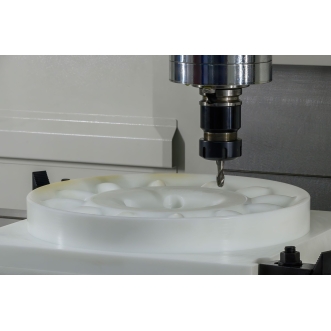
Milling is used to create flat surfaces, grooves, holes, and complex 3D shapes. Ball-nose end mills are often used for curved surfaces in implants and surgical components.
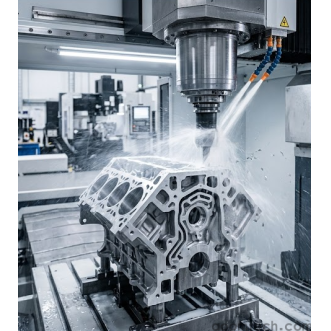
Proper chip removal and cooling are essential to maintain precision and prevent tool wear.
Turning
Turning is used for cylindrical parts such as pins, shafts, and connectors. The workpiece rotates while the cutting tool removes material.
Maintaining concentricity and smooth surface finish is critical in medical applications.
Drilling
Drilling creates precise holes required for assembly or medical function. Drill selection and cutting parameters must be carefully controlled to avoid inaccuracies or tool breakage.
Material Considerations for Medical Precision Parts
Biocompatible Metals
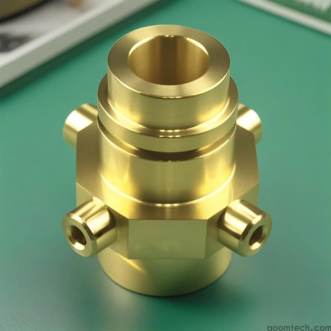
Common metals used in CNC machining for medical parts include titanium, stainless steel, and cobalt-chromium alloys.
Titanium: Lightweight, strong, and highly biocompatible, widely used in implants.
Stainless Steel: Corrosion-resistant and cost-effective for surgical tools.
Cobalt-Chromium: Extremely strong and wear-resistant, used in joint replacements.
These metals require specialized machining strategies due to hardness and heat resistance.
Medical-Grade Plastics
Plastics such as PEEK (Polyether Ether Ketone), polyethylene, and polycarbonate are widely used in medical devices.
They offer chemical resistance, lightweight properties, and good biocompatibility. However, they can deform under heat, so CNC machining must carefully control temperature and cutting speed.
Quality Control in CNC Machining of Medical Precision Parts
In-Process Inspection
Continuous monitoring during machining ensures that defects are detected early. Tools such as micrometers, optical systems, and surface roughness testers are used.
If deviations occur, operators adjust machining parameters immediately to maintain accuracy.
Final Inspection
After machining, parts undergo strict inspection using advanced equipment such as Coordinate Measuring Machines (CMMs).
Inspection checks include:
Dimensional accuracy
Surface finish quality
Material integrity
Functional performance
Non-conforming parts are either reworked or discarded depending on severity.
The Impact of CNC Machining on the Medical Industry
Advancement of Medical Technologies
CNC machining has enabled the development of advanced medical devices such as minimally invasive surgical tools, robotic surgical systems, and high-precision diagnostic equipment.
Complex geometries that were once impossible to manufacture can now be produced with high accuracy and consistency.
Enhanced Patient Safety and Comfort
High-precision CNC-machined components improve patient outcomes by ensuring better fit, function, and reliability.
Examples include custom orthopedic implants that match patient anatomy and surgical instruments that improve procedural accuracy and reduce recovery time.
Conclusion: Mastering CNC Machining for Medical Precision Parts
CNC machining is essential for producing safe, accurate, and reliable medical components. The success of CNC Machining for Medical Precision Parts depends on precision engineering, biocompatible materials, and strict quality control systems.
Key takeaways include the importance of:
Meeting extreme precision and tolerance requirements
Ensuring biocompatibility and cleanliness
Using suitable medical-grade materials
Applying strict quality control in CNC machining of medical parts
Manufacturers in the medical industry must continuously improve their skills, adopt advanced CNC technologies, and stay updated with global medical standards to ensure safe and reliable production.
RELATED PRODUCTS
-
Medical Brass CNC Machining Parts
-
Precision CNC Machining PEEK Services
-
Precision Custom CNC Machined Car Parts
-
cnc machining optical housings
-
Precision CNC Casting Machining Services
-
Precision Gear CNC Machining Services
-
Precision Stainless Steel Parts CNC Mach
-
CNC Machining of Precision Aluminum Tube
-
CNC Machining of Large Precision Aluminu
-
CNC Machining & Manufacturing of Pre